
The Peptide App Opens Public COA Evidence Index with 5,225 Documents
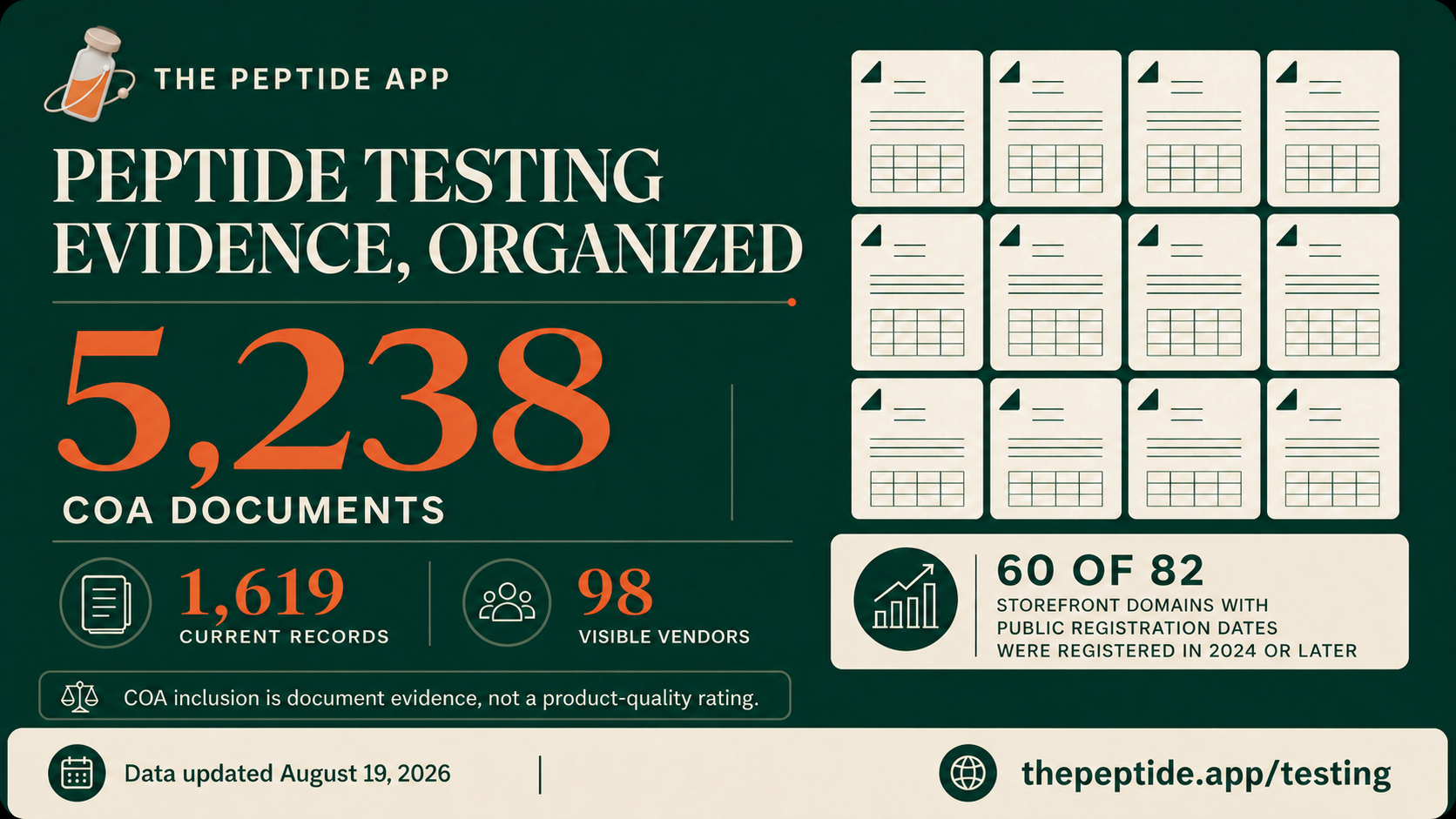
The Peptide App launched a free public COA Evidence Index containing 5,225 documents, along with a label-first reconstitution calculator. The launch addresses a fast-changing online peptide market: 60 of 82 storefront domains with available registration dates in the app’s current vendor sample were registered in 2024 or later. The index helps people inspect testing records, sources, and limitations without treating a COA as proof of product quality or safety.
Austin, TX, August 26, 2026 --(PR.com)-- The Peptide App today announced public access to two free web resources: a searchable Certificate of Analysis (COA) Evidence Index and a label-first peptide reconstitution calculator.
The launch comes as the online peptide market becomes more crowded and difficult to evaluate. The Peptide App currently tracks 98 visible vendors across 2,935 vendor–peptide pairs. In a review of 89 current storefront domains represented in its COA registry, public registration dates were available for 82. Of those, 60, or 73 percent, were registered in 2024 or later.
For people researching this market, the challenge is no longer simply finding a product listing. It is determining which certificate applies to which product, when it was tested, which laboratory the document names, and what the reported result can—and cannot—establish. Certificates are often scattered across product pages, testing libraries, PDFs, and images, with inconsistent naming and product associations.
As of August 19, 2026, the COA Evidence Index contains 5,225 documents and identifies 1,614 current records—the newest eligible document on file for each vendor–peptide pair. Among those current records, 1,600 include a printed laboratory name, 1,571 include a test date, and 1,414 report a purity result.
The index has at least one current record for 84 of 109 tracked peptides and 77 of 98 tracked vendors. Visitors can search by peptide, vendor, or laboratory, inspect available document fields, and open the associated COA. The records are also available through a read-only public API.
“The online peptide market is changing faster than the tools people have to make sense of it,” said Tony Llongueras, founder of The Peptide App. “New storefronts can appear quickly, while testing documents remain scattered and difficult to compare. We built the index so people can inspect the underlying evidence themselves. Trust is not a label we can give ourselves. It has to come from showing the source, the method, and the limits.”
The Peptide App treats inclusion in the index as document evidence, not a product endorsement or quality rating. A record indicates that its pipeline identified a stored document as a COA, matched the compound printed on the document to a catalog peptide, and associated it with a visible vendor listing.
A COA record does not establish a product’s authenticity, chain of custody, vial contents, sterility, safety, efficacy, or suitability for use. It also does not establish the quality of a vendor or laboratory. Reported purity values can differ in meaning across laboratories, instruments, and testing methods.
The free web calculator applies the same inspectable approach to reconstitution math. Users confirm a target amount from existing instructions and the amount printed on the vial. The calculator then displays supported whole-milliliter dilution scenarios and their concentration, milliliter, and U-100 syringe-unit conversions. Users who already have an instructed diluent volume can enter it directly.
The calculator does not select a dose, frequency, route, titration schedule, or preparation. Its arithmetic runs in the browser, requires no account, and is supported by a public methodology explaining its formulas, assumptions, privacy practices, and limitations.
The companion iPhone app brings guided reconstitution, protocol planning, reminders, dose logging, and progress tracking into one organized workflow.
The COA Evidence Index and reconstitution calculator are available free on the web.
Data and Methodology
COA counts reflect the public index as of August 19, 2026. A “current record” is the newest eligible COA document on file for a vendor–peptide pair. Vendors may publish multiple documents for the same listing over time, which is why the total document count is higher than the number of current records.
The storefront analysis examined 89 current vendor domains represented in The Peptide App’s COA registry using public Registration Data Access Protocol records. Registration dates were available for 82 domains, and 60 were registered between January 1, 2024, and August 20, 2026.
A domain registration date is not necessarily a company’s founding date. Rebrands, domain transfers, acquisitions, and website migrations can affect registration history. The analysis describes The Peptide App’s current registry sample and should not be interpreted as a complete market census or an exact industry growth rate.
About The Peptide App
The Peptide App is an iPhone app and web resource for educational peptide calculations, reconstitution organization, protocol planning, reminders, logging, and progress tracking. Its public website includes a free reconstitution calculator, peptide and vendor market data, and a searchable COA Evidence Index.
The Peptide App provides educational and informational tools, not medical advice. Interactions with third-party vendors are solely between the user and that vendor.
The launch comes as the online peptide market becomes more crowded and difficult to evaluate. The Peptide App currently tracks 98 visible vendors across 2,935 vendor–peptide pairs. In a review of 89 current storefront domains represented in its COA registry, public registration dates were available for 82. Of those, 60, or 73 percent, were registered in 2024 or later.
For people researching this market, the challenge is no longer simply finding a product listing. It is determining which certificate applies to which product, when it was tested, which laboratory the document names, and what the reported result can—and cannot—establish. Certificates are often scattered across product pages, testing libraries, PDFs, and images, with inconsistent naming and product associations.
As of August 19, 2026, the COA Evidence Index contains 5,225 documents and identifies 1,614 current records—the newest eligible document on file for each vendor–peptide pair. Among those current records, 1,600 include a printed laboratory name, 1,571 include a test date, and 1,414 report a purity result.
The index has at least one current record for 84 of 109 tracked peptides and 77 of 98 tracked vendors. Visitors can search by peptide, vendor, or laboratory, inspect available document fields, and open the associated COA. The records are also available through a read-only public API.
“The online peptide market is changing faster than the tools people have to make sense of it,” said Tony Llongueras, founder of The Peptide App. “New storefronts can appear quickly, while testing documents remain scattered and difficult to compare. We built the index so people can inspect the underlying evidence themselves. Trust is not a label we can give ourselves. It has to come from showing the source, the method, and the limits.”
The Peptide App treats inclusion in the index as document evidence, not a product endorsement or quality rating. A record indicates that its pipeline identified a stored document as a COA, matched the compound printed on the document to a catalog peptide, and associated it with a visible vendor listing.
A COA record does not establish a product’s authenticity, chain of custody, vial contents, sterility, safety, efficacy, or suitability for use. It also does not establish the quality of a vendor or laboratory. Reported purity values can differ in meaning across laboratories, instruments, and testing methods.
The free web calculator applies the same inspectable approach to reconstitution math. Users confirm a target amount from existing instructions and the amount printed on the vial. The calculator then displays supported whole-milliliter dilution scenarios and their concentration, milliliter, and U-100 syringe-unit conversions. Users who already have an instructed diluent volume can enter it directly.
The calculator does not select a dose, frequency, route, titration schedule, or preparation. Its arithmetic runs in the browser, requires no account, and is supported by a public methodology explaining its formulas, assumptions, privacy practices, and limitations.
The companion iPhone app brings guided reconstitution, protocol planning, reminders, dose logging, and progress tracking into one organized workflow.
The COA Evidence Index and reconstitution calculator are available free on the web.
Data and Methodology
COA counts reflect the public index as of August 19, 2026. A “current record” is the newest eligible COA document on file for a vendor–peptide pair. Vendors may publish multiple documents for the same listing over time, which is why the total document count is higher than the number of current records.
The storefront analysis examined 89 current vendor domains represented in The Peptide App’s COA registry using public Registration Data Access Protocol records. Registration dates were available for 82 domains, and 60 were registered between January 1, 2024, and August 20, 2026.
A domain registration date is not necessarily a company’s founding date. Rebrands, domain transfers, acquisitions, and website migrations can affect registration history. The analysis describes The Peptide App’s current registry sample and should not be interpreted as a complete market census or an exact industry growth rate.
About The Peptide App
The Peptide App is an iPhone app and web resource for educational peptide calculations, reconstitution organization, protocol planning, reminders, logging, and progress tracking. Its public website includes a free reconstitution calculator, peptide and vendor market data, and a searchable COA Evidence Index.
The Peptide App provides educational and informational tools, not medical advice. Interactions with third-party vendors are solely between the user and that vendor.
Contact
The Peptide App
Tony Llongueras
(512) 850-6706
https://thepeptide.app
Tony Llongueras
(512) 850-6706
https://thepeptide.app
 Contact
Categories