
River Ecosystems, Inc., Releases a Report on the Effects of Hydropower Peaking on Aquatic Invertebrates, Downstream from Fort Randall Dam, Missouri River
Macroinvertebrates are the predominant food source for fish, birds, reptiles and amphibians in the Missouri River. The study reach is a 39-mile section that is part of the Missouri National Recreational River, National Park Service.
Crofton, NE, May 18, 2026 --(PR.com)-- Effects of Peaking on Macroinvertebrates
A pilot study was completed in 1984, i.e. Hesse and Klammer, 1984, ‘Missouri River Ecology. Federal Aid in Sport Fish Restoration, Project F-75-R. Artificial substrates in the top 38% of the water column, averaged 2,178 macroinvertebrate larvae/square meter; samplers deeper in the column, subjected to less fluctuations averaged 4,252 larvae/square meter.
Mestl, Hesse, Oates, Borland, Fritzen (Nebraska Game and Parks), and David Marx (Professor of Statistics, UNL), 1991, ‘The effects of hydropower peaking operations at Fort Randall Dam, Missouri River, on Aufwuchs, downriver’, Federal Aid in Sport Fish Restoration Project F-75-R-8. The German term Aufwuchs comprises all organisms, attached to substrates, e.g. plant stems, rocks, etc., in river ecosystems, but excluding plants. American authors often use the term, periphyton, though Aufwuchs is the more inclusive term (Franz Ruttner, 1953, Fundamentals of Limnology. Main-channel and chute Aufwuchs habitat in the middle Missouri River had the highest annual production, 42.4 and 68.8 g/m2 of all aquatic habitats studied (Hesse, L.W. 2025. “8emessourit” ‘The River of the Big Canoes).
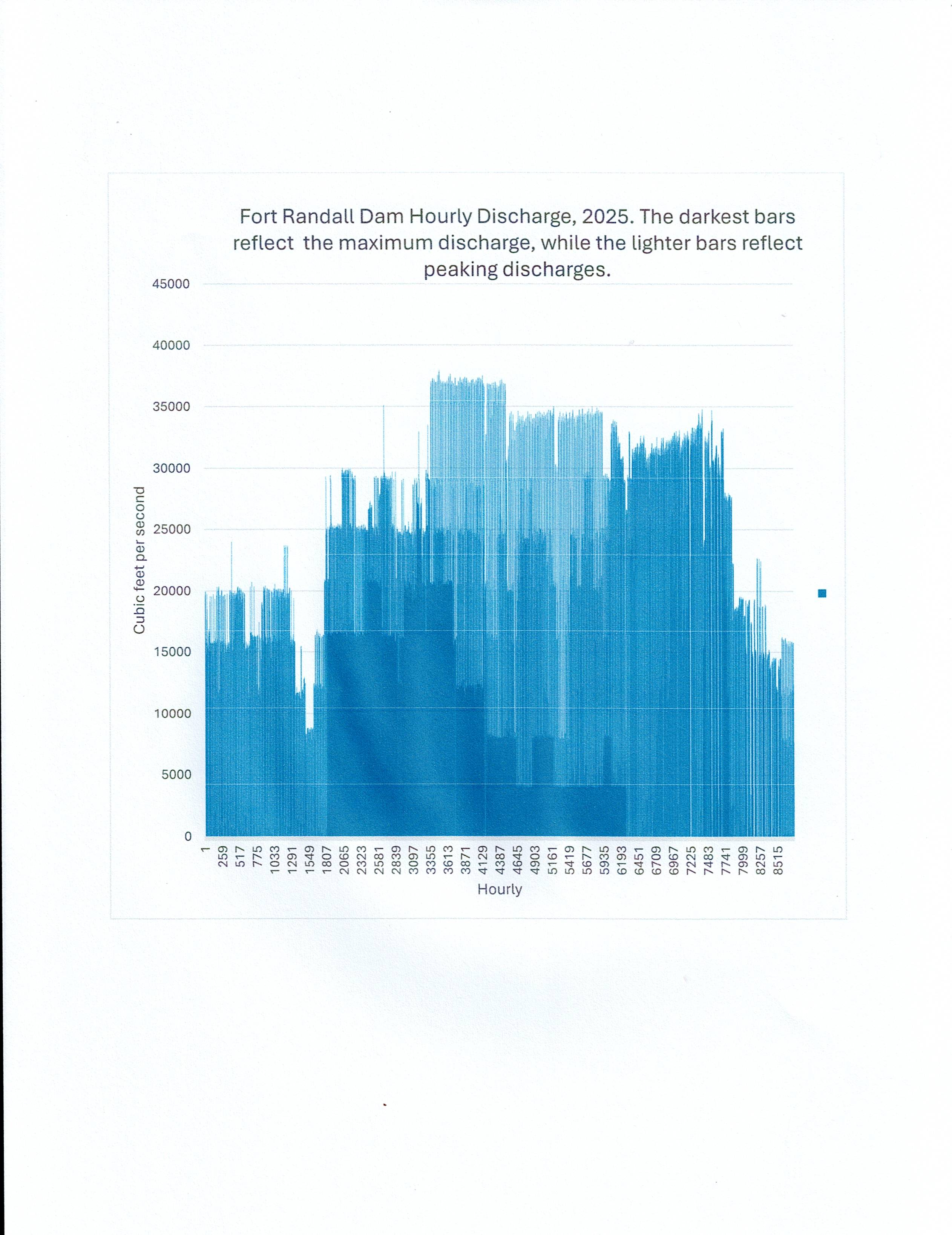
The follow-up study was conducted during 18, three-week periods in 1987-1988. Hester-Dendy artificial substrate, multi-plant samplers were used. The study period experienced an extreme magnitude of peaking. Stationary platforms (anchored to the bottom) in the fluctuation zone, would have had to be tall enough, to remain submerged, in the range of, zero to 45,000 cubic feet per second (cfs). Units would have to span nearly 9.2 vertical feet, for the lowermost plates to remain submerged. The only place with this depth range, was the main channel. The control was a floating platform that allowed multi-plates to rise and fall with discharge, thus maintaining maximum submersal.
Two, three-week periods were selected that represented low magnitude peaking (1 May – 22 May), and high magnitude peaking (4 August – 23 August). Total mean density was much higher in May (mean = 130.8 organisms/per plate), than in August (25.1 organisms/plate). The conclusion was, that the very low density in August was a result of high magnitude peaking. Even though any type of peaking had a negative impact on Aufwuchs insect communities, the effect may be lessened somewhat by a reduced level of peaking discharge.
It was determined that time of exposure was significantly related to density in a correlation in May (P = 0.02; r = 0.81148), and August (P = 0.03; r = 0.79717). The longer a unit was exposed to air the lower the density was on that unit. This suggests that the impact of peaking could be minimized, somewhat, by reducing the magnitude of peaking.
Peaking from Fort Randall Dam, has a significantly negative impact, on secondary production in the entire 39-mile reach, from Fort Randall tailwater to Lewis and Clark headwaters. Since these two functions were authorized purposes for operations at this dam, it is problematic to suggest elimination of these functions.
However, there is an alternative solution, i.e. re-direct the White River, which empties into Lake Francis Case, to empty into the tailwater.
Key Flow Metrics of the White River:
Maximum Discharge: 51,900 cfs
Low Flow (Example): Near Interior, SD, recent flows have shown a median discharge of 168 cfs
Recent High Events: The White River near the NE-SD state line recorded a peak of over 4,000 cfs in May 2015.
Annual average discharge into Lake Francis Case: 570 cfs.
The White River is highly turbid and warmer than the discharge from Fort Randall Dam. There are multiple benefits associated with this project, which includes: peaking mitigation, downstream sediment and organic matter transport, increased turbidity, increased water temperature, fish bypass canal, and reduced sedimentation in Lake Francis Case.
A pilot study was completed in 1984, i.e. Hesse and Klammer, 1984, ‘Missouri River Ecology. Federal Aid in Sport Fish Restoration, Project F-75-R. Artificial substrates in the top 38% of the water column, averaged 2,178 macroinvertebrate larvae/square meter; samplers deeper in the column, subjected to less fluctuations averaged 4,252 larvae/square meter.
Mestl, Hesse, Oates, Borland, Fritzen (Nebraska Game and Parks), and David Marx (Professor of Statistics, UNL), 1991, ‘The effects of hydropower peaking operations at Fort Randall Dam, Missouri River, on Aufwuchs, downriver’, Federal Aid in Sport Fish Restoration Project F-75-R-8. The German term Aufwuchs comprises all organisms, attached to substrates, e.g. plant stems, rocks, etc., in river ecosystems, but excluding plants. American authors often use the term, periphyton, though Aufwuchs is the more inclusive term (Franz Ruttner, 1953, Fundamentals of Limnology. Main-channel and chute Aufwuchs habitat in the middle Missouri River had the highest annual production, 42.4 and 68.8 g/m2 of all aquatic habitats studied (Hesse, L.W. 2025. “8emessourit” ‘The River of the Big Canoes).
The follow-up study was conducted during 18, three-week periods in 1987-1988. Hester-Dendy artificial substrate, multi-plant samplers were used. The study period experienced an extreme magnitude of peaking. Stationary platforms (anchored to the bottom) in the fluctuation zone, would have had to be tall enough, to remain submerged, in the range of, zero to 45,000 cubic feet per second (cfs). Units would have to span nearly 9.2 vertical feet, for the lowermost plates to remain submerged. The only place with this depth range, was the main channel. The control was a floating platform that allowed multi-plates to rise and fall with discharge, thus maintaining maximum submersal.
Two, three-week periods were selected that represented low magnitude peaking (1 May – 22 May), and high magnitude peaking (4 August – 23 August). Total mean density was much higher in May (mean = 130.8 organisms/per plate), than in August (25.1 organisms/plate). The conclusion was, that the very low density in August was a result of high magnitude peaking. Even though any type of peaking had a negative impact on Aufwuchs insect communities, the effect may be lessened somewhat by a reduced level of peaking discharge.
It was determined that time of exposure was significantly related to density in a correlation in May (P = 0.02; r = 0.81148), and August (P = 0.03; r = 0.79717). The longer a unit was exposed to air the lower the density was on that unit. This suggests that the impact of peaking could be minimized, somewhat, by reducing the magnitude of peaking.
Peaking from Fort Randall Dam, has a significantly negative impact, on secondary production in the entire 39-mile reach, from Fort Randall tailwater to Lewis and Clark headwaters. Since these two functions were authorized purposes for operations at this dam, it is problematic to suggest elimination of these functions.
However, there is an alternative solution, i.e. re-direct the White River, which empties into Lake Francis Case, to empty into the tailwater.
Key Flow Metrics of the White River:
Maximum Discharge: 51,900 cfs
Low Flow (Example): Near Interior, SD, recent flows have shown a median discharge of 168 cfs
Recent High Events: The White River near the NE-SD state line recorded a peak of over 4,000 cfs in May 2015.
Annual average discharge into Lake Francis Case: 570 cfs.
The White River is highly turbid and warmer than the discharge from Fort Randall Dam. There are multiple benefits associated with this project, which includes: peaking mitigation, downstream sediment and organic matter transport, increased turbidity, increased water temperature, fish bypass canal, and reduced sedimentation in Lake Francis Case.
Contact
River Ecosystems, Inc
Lawrence W. Hesse
402-640-7809
https://www.linkedin.com/in/larry-hesse-522ba1346/
Lawrence W. Hesse
Lawrence W. Hesse
402-640-7809
https://www.linkedin.com/in/larry-hesse-522ba1346/
Lawrence W. Hesse
 Contact
Categories