
Iridium CE’s AI Patient Simulation Identifies SDOH Gaps in IBD Care, Earns NAMEC Best Practice Award
Program pairs certified CME with conversational AI patient simulation to reveal what traditional testing cannot: the gap between what clinicians know and what they do in a case simulation.
Apex, NC, February 23, 2026 --(PR.com)-- Iridium Continuing Education, Inc. has received the National Association of Medical Education Companies’ (NAMEC) Best Practice in Innovative Educational Methods award for “Empowering Patients, Elevating Care: Improving Cultural Competency in Inflammatory Bowel Disease (IBD) Care.” The award was presented on February 16, 2026, at the Alliance for Continuing Education in the Health Professions Annual Conference in Atlanta, Georgia, recognizing a program that represents a new paradigm in how continuing medical education is designed, delivered, and measured.
Developed in partnership with Color of Gastrointestinal Illnesses (COGI) and Global Education Group (Global) and led by a nationally recognized faculty panel, the program does something most CME cannot: it moves beyond testing what clinicians know and measures how they apply that knowledge in realistic clinical encounters.
How the Simulation Works
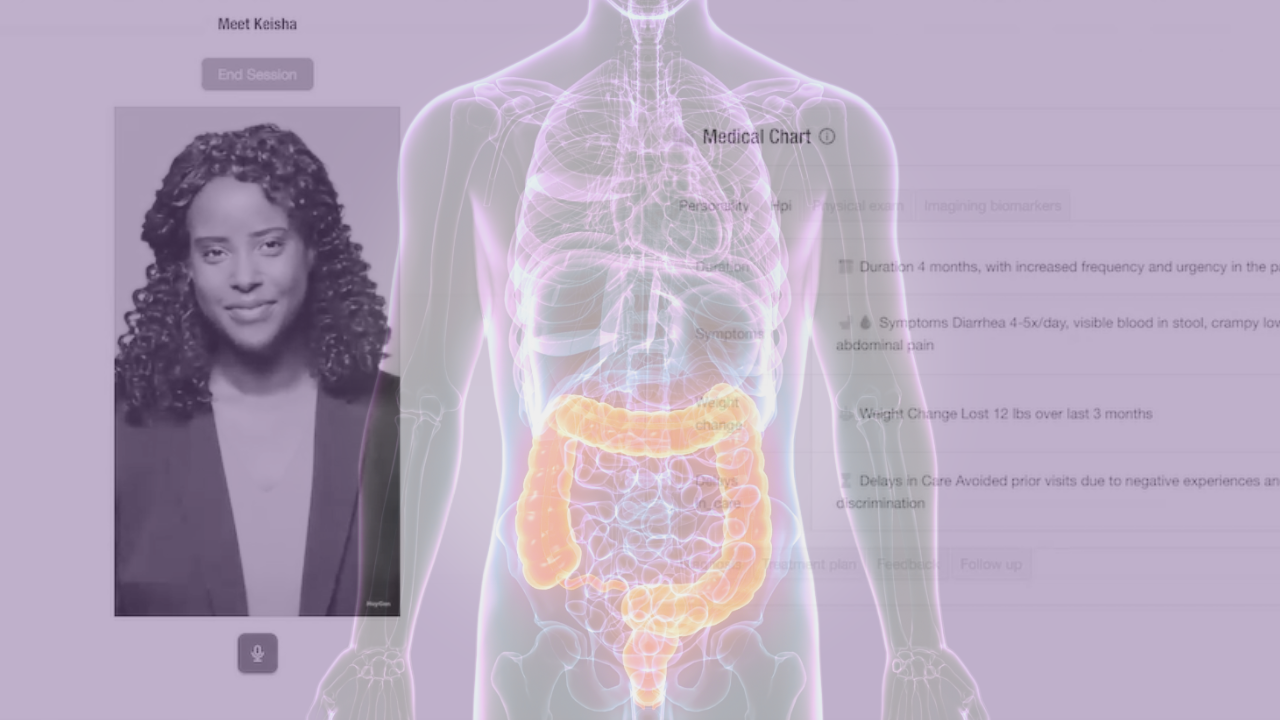
After completing expert-led content on SDOH-informed IBD care, learners enter a conversational AI simulation where they encounter virtual patients with embedded social determinants that surface only if the clinician probes. A clinically correct plan can be a functionally useless plan if the clinician never uncovers the barriers. The conversational AI patient simulation captures what clinicians ask, what they miss, and whether an evidence-based treatment plan survives contact with a patient’s real life.
Uncovering the “Knowing–Doing” Gap
By every traditional measure, the program is a success. Learners demonstrate statistically significant gains in knowledge and competence. But when those same learners engage with AI patients, a different picture emerges.
Across key domains, including SDOH barrier screening, feasibility assessment, and treatment preference exploration, learners who perform well on post-test questions frequently fail to apply those same concepts in simulated patient encounters. The gaps are consistent and measurable: a majority of learners never explore housing-related barriers, do not plan for transportation or time off work, and do not address cultural considerations, all directly relevant to whether an IBD treatment plan is sustainable.
“Our learners score well on every question about equitable care. But when they sit across from a simulated patient with real-world barriers, many default to plans that assume the patient can get to follow-up appointments, afford the regimen, and navigate the system without friction. That gap between knowing and doing is exactly where disparities live,” said Melissa Wiles, President of Iridium CE.
What makes this model different is what it gives CME at scale: the ability to measure clinical decision-making in action. To date, over 885 unique encounters have been scored against a standardized rubric, generating individualized data that previously required Objective Structured Clinical Examinations (OSCEs), but without those constraints and with far greater specificity. The platform identifies exactly which domains each clinician misses, how they miss them, and at what point in the encounter the gap occurs.
That level of granularity transforms needs assessment into a real-time, evidence-based process, actionable at the individual learner level, across regional cohorts, or at a national scale. For learners, observed gaps become targeted feedback that pinpoints exactly where their clinical conversations fall short. For patients, the simulation creates a safety net, catching blind spots in SDOH-informed care before they reach the bedside. For stakeholders, it delivers something traditional assessment cannot: measurable evidence that education changes clinical decision-making.
With over 885 program learners to date spanning the United States and eight countries, Iridium plans to continue analyzing simulation data to inform the design of future IBD programming and to adapt this model to other therapeutic areas where outcomes depend on shared decision-making, adherence, access, or social context. Findings will be disseminated through peer-reviewed publications and conference presentations.
This activity is supported by an educational grant from Takeda Pharmaceuticals U.S.A., Inc.
About the Collaborating Organizations
Iridium Continuing Education is an award-winning medical education company dedicated to improving healthcare outcomes through innovative, outcomes-driven educational programming.
Global Education Group’s mission is to effectively manage, design, implement, and measure the healthcare impact of continuing education interventions that promote clinical competence and performance improvement.
About the NAMEC Best Practices Award
The National Association of Medical Education Companies, Inc. (NAMEC) is a professional association dedicated to providing representation, advocacy, and education for its members. The NAMEC Best Practices Award, presented at the Alliance for Continuing Education in the Health Professions Annual Conference, recognizes excellence and innovation in medical education.
Developed in partnership with Color of Gastrointestinal Illnesses (COGI) and Global Education Group (Global) and led by a nationally recognized faculty panel, the program does something most CME cannot: it moves beyond testing what clinicians know and measures how they apply that knowledge in realistic clinical encounters.
How the Simulation Works
After completing expert-led content on SDOH-informed IBD care, learners enter a conversational AI simulation where they encounter virtual patients with embedded social determinants that surface only if the clinician probes. A clinically correct plan can be a functionally useless plan if the clinician never uncovers the barriers. The conversational AI patient simulation captures what clinicians ask, what they miss, and whether an evidence-based treatment plan survives contact with a patient’s real life.
Uncovering the “Knowing–Doing” Gap
By every traditional measure, the program is a success. Learners demonstrate statistically significant gains in knowledge and competence. But when those same learners engage with AI patients, a different picture emerges.
Across key domains, including SDOH barrier screening, feasibility assessment, and treatment preference exploration, learners who perform well on post-test questions frequently fail to apply those same concepts in simulated patient encounters. The gaps are consistent and measurable: a majority of learners never explore housing-related barriers, do not plan for transportation or time off work, and do not address cultural considerations, all directly relevant to whether an IBD treatment plan is sustainable.
“Our learners score well on every question about equitable care. But when they sit across from a simulated patient with real-world barriers, many default to plans that assume the patient can get to follow-up appointments, afford the regimen, and navigate the system without friction. That gap between knowing and doing is exactly where disparities live,” said Melissa Wiles, President of Iridium CE.
What makes this model different is what it gives CME at scale: the ability to measure clinical decision-making in action. To date, over 885 unique encounters have been scored against a standardized rubric, generating individualized data that previously required Objective Structured Clinical Examinations (OSCEs), but without those constraints and with far greater specificity. The platform identifies exactly which domains each clinician misses, how they miss them, and at what point in the encounter the gap occurs.
That level of granularity transforms needs assessment into a real-time, evidence-based process, actionable at the individual learner level, across regional cohorts, or at a national scale. For learners, observed gaps become targeted feedback that pinpoints exactly where their clinical conversations fall short. For patients, the simulation creates a safety net, catching blind spots in SDOH-informed care before they reach the bedside. For stakeholders, it delivers something traditional assessment cannot: measurable evidence that education changes clinical decision-making.
With over 885 program learners to date spanning the United States and eight countries, Iridium plans to continue analyzing simulation data to inform the design of future IBD programming and to adapt this model to other therapeutic areas where outcomes depend on shared decision-making, adherence, access, or social context. Findings will be disseminated through peer-reviewed publications and conference presentations.
This activity is supported by an educational grant from Takeda Pharmaceuticals U.S.A., Inc.
About the Collaborating Organizations
Iridium Continuing Education is an award-winning medical education company dedicated to improving healthcare outcomes through innovative, outcomes-driven educational programming.
Global Education Group’s mission is to effectively manage, design, implement, and measure the healthcare impact of continuing education interventions that promote clinical competence and performance improvement.
About the NAMEC Best Practices Award
The National Association of Medical Education Companies, Inc. (NAMEC) is a professional association dedicated to providing representation, advocacy, and education for its members. The NAMEC Best Practices Award, presented at the Alliance for Continuing Education in the Health Professions Annual Conference, recognizes excellence and innovation in medical education.
Contact
Iridium CE
919-357-2609
www.iridiumce.com
919-357-2609
www.iridiumce.com
 Contact
Categories