
Strengthening M&A Due Diligence with Risk Cognizance
How a Financial Services SaaS Provider Turned Cyber Due Diligence from a Bottleneck Into a Competitive Advantage
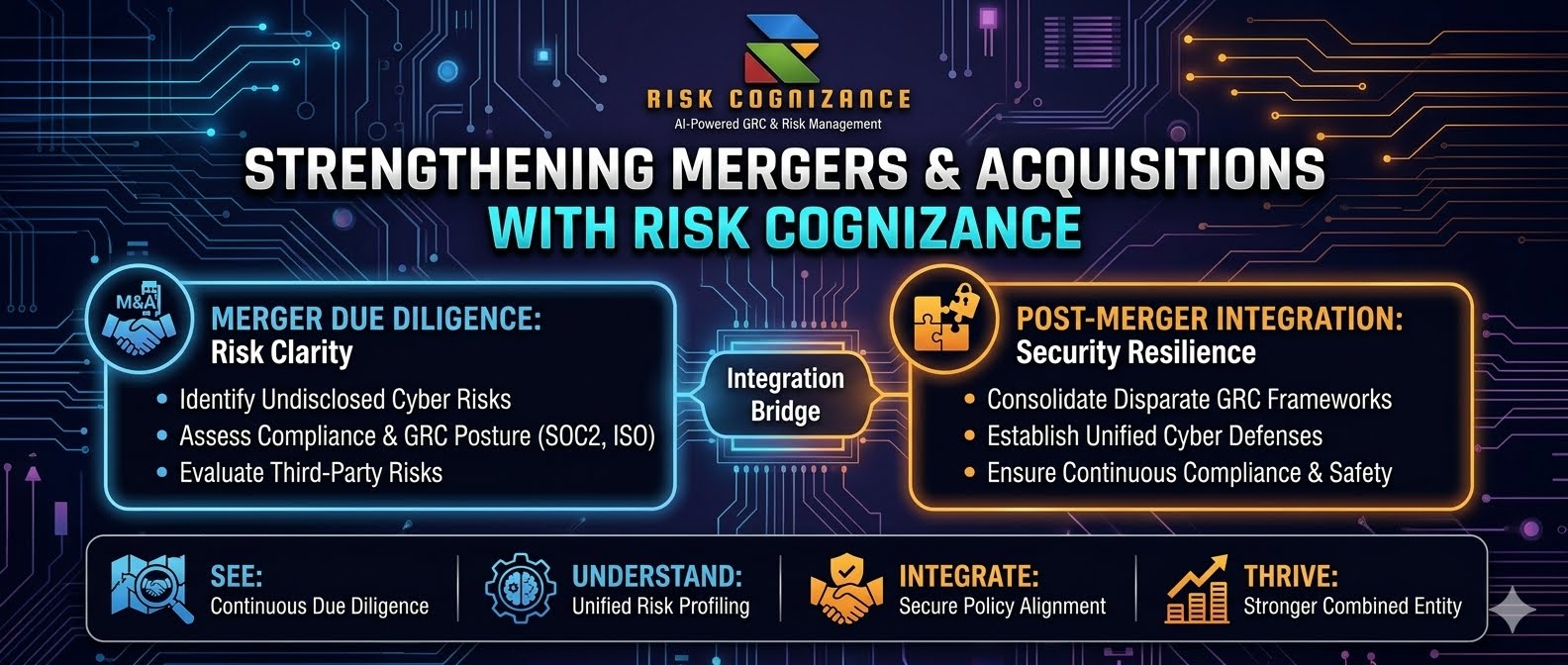
New York, NY, August 12, 2026 --(PR.com)-- Strengthening Mergers & Acquisitions with Risk Cognizance.
How a Financial Services SaaS Provider Turned Cyber Due Diligence From a Bottleneck Into a Competitive Advantage
A mid-market financial services SaaS provider, referred to here as Meridian Ledger (a composite profile representative of this segment), was closing two to four acquisitions a year but consistently found that cyber and compliance due diligence was the slowest, least predictable part of every deal. Manual vendor questionnaires and point-in-time security reviews routinely added two to three weeks to deal timelines and, on at least one prior acquisition, missed a compliance gap that surfaced only after close.
After deploying Risk Cognizance, Meridian Ledger cut its cyber and compliance due diligence window from an average of three weeks to under five days, gained continuous visibility into target companies' security posture instead of a single static snapshot, and built a repeatable, auditable diligence process that satisfied both its board and its regulators. The result: faster deal cycles, fewer post-close surprises, and a due diligence function that started being viewed as a deal enabler instead of a bottleneck.
What is M&A Due Diligence?
M&A due diligence is the detailed review and verification process a buyer conducts to evaluate a target company's financial health, legal standing, and operational risks before finalizing a merger or acquisition. It helps confirm the business's value, uncover hidden liabilities, and shape the final deal terms.
Key Areas of Review
Financial. Inspecting balance sheets, income statements, cash flow, tax compliance, and debt obligations.
Legal. Checking active lawsuits, regulatory compliance, corporate governance, and major contracts.
Operational and IT. Evaluating software, hardware, cybersecurity, supply chains, and day-to-day workflows.
Commercial. Analyzing market share, customer retention, and competitor dynamics.
Human resources. Assessing employee contracts, benefit plans, key talent, and corporate culture alignment.
Why it is Critical
Validates valuation. Confirms that the target company's financial statements accurately reflect its real market value.
Exposes hidden liabilities. Uncovers undisclosed debts, pending lawsuits, tax issues, or intellectual property gaps.
Enhances negotiating power. Provides objective data to demand a price reduction or include strict indemnity clauses.
Reduces post-deal risk. Pinpoints immediate operational friction, cybersecurity vulnerabilities, and cultural mismatches.
Protects fiduciary duty. Proves to corporate boards, shareholders, and lenders that management exercised proper caution.
The case study below focuses specifically on the operational and IT slice of that review, cybersecurity posture and regulatory compliance, which has historically been one of the hardest areas to assess quickly and reliably, and is where Meridian Ledger's process changed the most.
About the Organization
Meridian Ledger provides core banking and payments infrastructure software to regional banks and credit unions. Operating under SOC 2, ISO 27001, and multiple state-level financial privacy regulations, the company had grown partly through acquisition, absorbing smaller fintech point solutions to expand its product suite. Each acquisition brought its own technology stack, its own vendor relationships, and its own security posture, often undocumented or inconsistently maintained.
On one prior acquisition, this gap had real consequences: a compliance shortfall in the target's customer data handling practices wasn't discovered until after close, triggering a costly remediation effort that a more current, continuous view of the target's posture would likely have caught during diligence instead.
With the board pushing for a more aggressive acquisition pace, the corporate development and security teams needed a way to assess a target's real cyber and compliance risk in days, not weeks, without asking a two-person compliance team to do the impossible.
The Solution: Continuous, Cross-Framework Risk Intelligence Applied to Diligence
Meridian Ledger deployed Risk Cognizance as the backbone of its M&A due diligence process, applying capabilities originally built for ongoing third-party risk management to the compressed timeline of a deal.
Rapid, Structured Risk Intake
Instead of a generic questionnaire, Meridian Ledger used Risk Cognizance's automated risk questionnaires, tailored to the specific regulatory obligations relevant to each target, and tracked responses in the same system used for its existing vendor risk program rather than a one-off spreadsheet built for each deal.
Diligence Beyond Legalities: Traditional due diligence focuses heavily on contracts and balance sheets. Modern M&A requires continuous technical auditing to ensure the buyer isn't inheriting massive cybersecurity liabilities or software vulnerabilities.
Mitigating Culture & Process Friction: Most mergers lose momentum during the post-close phase due to fragmented governance structures. Standardizing risk reporting taxonomies via an automated GRC system keeps both legacy entities aligned.
Real-Time Asset Visibility: Implementing continuous risk and compliance tracking immediately upon acquisition ensures the parent company has absolute visibility over the new asset's cloud perimeters, access points, and compliance postures from day one.
External Visibility Without Waiting for Target Access
Before the target ever granted internal system access, Risk Cognizance's attack surface management and dark web monitoring gave the deal team an outside-in view: exposed assets, forgotten subdomains, and any indication of leaked credentials tied to the target's domains. This gave Meridian Ledger a real signal of the target's security hygiene well before formal technical diligence began.
Cross-Framework Compliance Mapping
Once a target's compliance documentation was in hand, Risk Cognizance's cross-framework mapping engine compared it directly against Meridian Ledger's own SOC 2, ISO 27001, and state privacy obligations, immediately surfacing gaps rather than requiring the compliance team to manually reconcile two separate control frameworks line by line.
Continuous Monitoring Through Close and Integration
Rather than treating diligence as a single point-in-time review, Meridian Ledger kept the target under continuous monitoring from signing through close and into post-acquisition integration, so any change in the target's posture, a new vulnerability, a configuration drift, a vendor incident, surfaced immediately instead of at the next scheduled review.
A Centralized, Auditable Record
Every finding, questionnaire response, and remediation item was logged in Risk Cognizance's evidence locker, giving Meridian Ledger's board and its own regulators a clear, defensible record of the diligence process for every deal, not just a folder of emails and PDF reports assembled after the fact.
Results
Beyond the metrics, the qualitative shift mattered just as much: due diligence stopped being the function that slowed deals down and became a function the corporate development team could rely on to move at the speed the business wanted to move.
In Their Words
"We used to treat cyber due diligence as a box to check before we could get back to the parts of the deal that actually moved it forward. Now it's one of the first things we look at, because it's fast enough to actually inform the decision instead of just documenting it after the fact." — VP of Risk & Compliance, Meridian Ledger
Benefits for the Company Being Acquired
Due diligence isn't only a burden for the acquirer. For the company being evaluated, being on the receiving end of a Risk Cognizance-powered review carries its own advantages, whether or not the target uses the platform itself.
A faster, less disruptive process. Structured, automated intake replaces the usual back-and-forth of ad hoc questionnaires and follow-up emails, meaning fewer hours pulled from the target's own security and engineering staff during an already stressful period.
A clear, defensible record of good posture. A target that can respond to diligence with current, well-organized evidence, rather than scrambling to produce a year-old pentest report, comes across as materially lower risk, which can directly support valuation and reduce the odds of a price adjustment tied to security findings.
Fewer surprises sprung late in the deal. Because gaps surface early through cross-framework mapping rather than emerging after a slow manual review, target companies get the chance to remediate or explain an issue before it becomes last-minute leverage for the acquirer at the negotiating table.
A smoother path through post-close integration. Continuous monitoring that starts during diligence carries forward into integration, so the target's security and compliance team isn't starting over with a new set of tools and expectations the day the deal closes.
A credible answer if they're preparing to be acquired. A target company that adopts the same kind of continuous risk monitoring proactively, before a deal is even on the table, walks into diligence able to demonstrate posture on demand instead of reconstructing it under deadline pressure, often shortening the process further and strengthening its negotiating position.
www.riskcognizance.com
How a Financial Services SaaS Provider Turned Cyber Due Diligence From a Bottleneck Into a Competitive Advantage
A mid-market financial services SaaS provider, referred to here as Meridian Ledger (a composite profile representative of this segment), was closing two to four acquisitions a year but consistently found that cyber and compliance due diligence was the slowest, least predictable part of every deal. Manual vendor questionnaires and point-in-time security reviews routinely added two to three weeks to deal timelines and, on at least one prior acquisition, missed a compliance gap that surfaced only after close.
After deploying Risk Cognizance, Meridian Ledger cut its cyber and compliance due diligence window from an average of three weeks to under five days, gained continuous visibility into target companies' security posture instead of a single static snapshot, and built a repeatable, auditable diligence process that satisfied both its board and its regulators. The result: faster deal cycles, fewer post-close surprises, and a due diligence function that started being viewed as a deal enabler instead of a bottleneck.
What is M&A Due Diligence?
M&A due diligence is the detailed review and verification process a buyer conducts to evaluate a target company's financial health, legal standing, and operational risks before finalizing a merger or acquisition. It helps confirm the business's value, uncover hidden liabilities, and shape the final deal terms.
Key Areas of Review
Financial. Inspecting balance sheets, income statements, cash flow, tax compliance, and debt obligations.
Legal. Checking active lawsuits, regulatory compliance, corporate governance, and major contracts.
Operational and IT. Evaluating software, hardware, cybersecurity, supply chains, and day-to-day workflows.
Commercial. Analyzing market share, customer retention, and competitor dynamics.
Human resources. Assessing employee contracts, benefit plans, key talent, and corporate culture alignment.
Why it is Critical
Validates valuation. Confirms that the target company's financial statements accurately reflect its real market value.
Exposes hidden liabilities. Uncovers undisclosed debts, pending lawsuits, tax issues, or intellectual property gaps.
Enhances negotiating power. Provides objective data to demand a price reduction or include strict indemnity clauses.
Reduces post-deal risk. Pinpoints immediate operational friction, cybersecurity vulnerabilities, and cultural mismatches.
Protects fiduciary duty. Proves to corporate boards, shareholders, and lenders that management exercised proper caution.
The case study below focuses specifically on the operational and IT slice of that review, cybersecurity posture and regulatory compliance, which has historically been one of the hardest areas to assess quickly and reliably, and is where Meridian Ledger's process changed the most.
About the Organization
Meridian Ledger provides core banking and payments infrastructure software to regional banks and credit unions. Operating under SOC 2, ISO 27001, and multiple state-level financial privacy regulations, the company had grown partly through acquisition, absorbing smaller fintech point solutions to expand its product suite. Each acquisition brought its own technology stack, its own vendor relationships, and its own security posture, often undocumented or inconsistently maintained.
On one prior acquisition, this gap had real consequences: a compliance shortfall in the target's customer data handling practices wasn't discovered until after close, triggering a costly remediation effort that a more current, continuous view of the target's posture would likely have caught during diligence instead.
With the board pushing for a more aggressive acquisition pace, the corporate development and security teams needed a way to assess a target's real cyber and compliance risk in days, not weeks, without asking a two-person compliance team to do the impossible.
The Solution: Continuous, Cross-Framework Risk Intelligence Applied to Diligence
Meridian Ledger deployed Risk Cognizance as the backbone of its M&A due diligence process, applying capabilities originally built for ongoing third-party risk management to the compressed timeline of a deal.
Rapid, Structured Risk Intake
Instead of a generic questionnaire, Meridian Ledger used Risk Cognizance's automated risk questionnaires, tailored to the specific regulatory obligations relevant to each target, and tracked responses in the same system used for its existing vendor risk program rather than a one-off spreadsheet built for each deal.
Diligence Beyond Legalities: Traditional due diligence focuses heavily on contracts and balance sheets. Modern M&A requires continuous technical auditing to ensure the buyer isn't inheriting massive cybersecurity liabilities or software vulnerabilities.
Mitigating Culture & Process Friction: Most mergers lose momentum during the post-close phase due to fragmented governance structures. Standardizing risk reporting taxonomies via an automated GRC system keeps both legacy entities aligned.
Real-Time Asset Visibility: Implementing continuous risk and compliance tracking immediately upon acquisition ensures the parent company has absolute visibility over the new asset's cloud perimeters, access points, and compliance postures from day one.
External Visibility Without Waiting for Target Access
Before the target ever granted internal system access, Risk Cognizance's attack surface management and dark web monitoring gave the deal team an outside-in view: exposed assets, forgotten subdomains, and any indication of leaked credentials tied to the target's domains. This gave Meridian Ledger a real signal of the target's security hygiene well before formal technical diligence began.
Cross-Framework Compliance Mapping
Once a target's compliance documentation was in hand, Risk Cognizance's cross-framework mapping engine compared it directly against Meridian Ledger's own SOC 2, ISO 27001, and state privacy obligations, immediately surfacing gaps rather than requiring the compliance team to manually reconcile two separate control frameworks line by line.
Continuous Monitoring Through Close and Integration
Rather than treating diligence as a single point-in-time review, Meridian Ledger kept the target under continuous monitoring from signing through close and into post-acquisition integration, so any change in the target's posture, a new vulnerability, a configuration drift, a vendor incident, surfaced immediately instead of at the next scheduled review.
A Centralized, Auditable Record
Every finding, questionnaire response, and remediation item was logged in Risk Cognizance's evidence locker, giving Meridian Ledger's board and its own regulators a clear, defensible record of the diligence process for every deal, not just a folder of emails and PDF reports assembled after the fact.
Results
Beyond the metrics, the qualitative shift mattered just as much: due diligence stopped being the function that slowed deals down and became a function the corporate development team could rely on to move at the speed the business wanted to move.
In Their Words
"We used to treat cyber due diligence as a box to check before we could get back to the parts of the deal that actually moved it forward. Now it's one of the first things we look at, because it's fast enough to actually inform the decision instead of just documenting it after the fact." — VP of Risk & Compliance, Meridian Ledger
Benefits for the Company Being Acquired
Due diligence isn't only a burden for the acquirer. For the company being evaluated, being on the receiving end of a Risk Cognizance-powered review carries its own advantages, whether or not the target uses the platform itself.
A faster, less disruptive process. Structured, automated intake replaces the usual back-and-forth of ad hoc questionnaires and follow-up emails, meaning fewer hours pulled from the target's own security and engineering staff during an already stressful period.
A clear, defensible record of good posture. A target that can respond to diligence with current, well-organized evidence, rather than scrambling to produce a year-old pentest report, comes across as materially lower risk, which can directly support valuation and reduce the odds of a price adjustment tied to security findings.
Fewer surprises sprung late in the deal. Because gaps surface early through cross-framework mapping rather than emerging after a slow manual review, target companies get the chance to remediate or explain an issue before it becomes last-minute leverage for the acquirer at the negotiating table.
A smoother path through post-close integration. Continuous monitoring that starts during diligence carries forward into integration, so the target's security and compliance team isn't starting over with a new set of tools and expectations the day the deal closes.
A credible answer if they're preparing to be acquired. A target company that adopts the same kind of continuous risk monitoring proactively, before a deal is even on the table, walks into diligence able to demonstrate posture on demand instead of reconstructing it under deadline pressure, often shortening the process further and strengthening its negotiating position.
www.riskcognizance.com
Contact
Risk Cognizance
Jeffery Walker
1 (833) 724-7475
www.riskcognizance.com
Jeffery Walker
1 (833) 724-7475
www.riskcognizance.com
 Contact
Categories