
Emotion AI Thinks There's One Right Answer. A High School Researcher is Proving There Isn't.
A non-commercial research project led by high school student Evelyn Kim at Singapore American School has opened public participation. Contributors watch ten short video clips and record how they read each person's emotion — no right or wrong answers, 10 to 15 minutes. The study challenges a foundational assumption of emotion-recognition AI: that everyone reads a face the same way. Anyone 14 or older can participate.
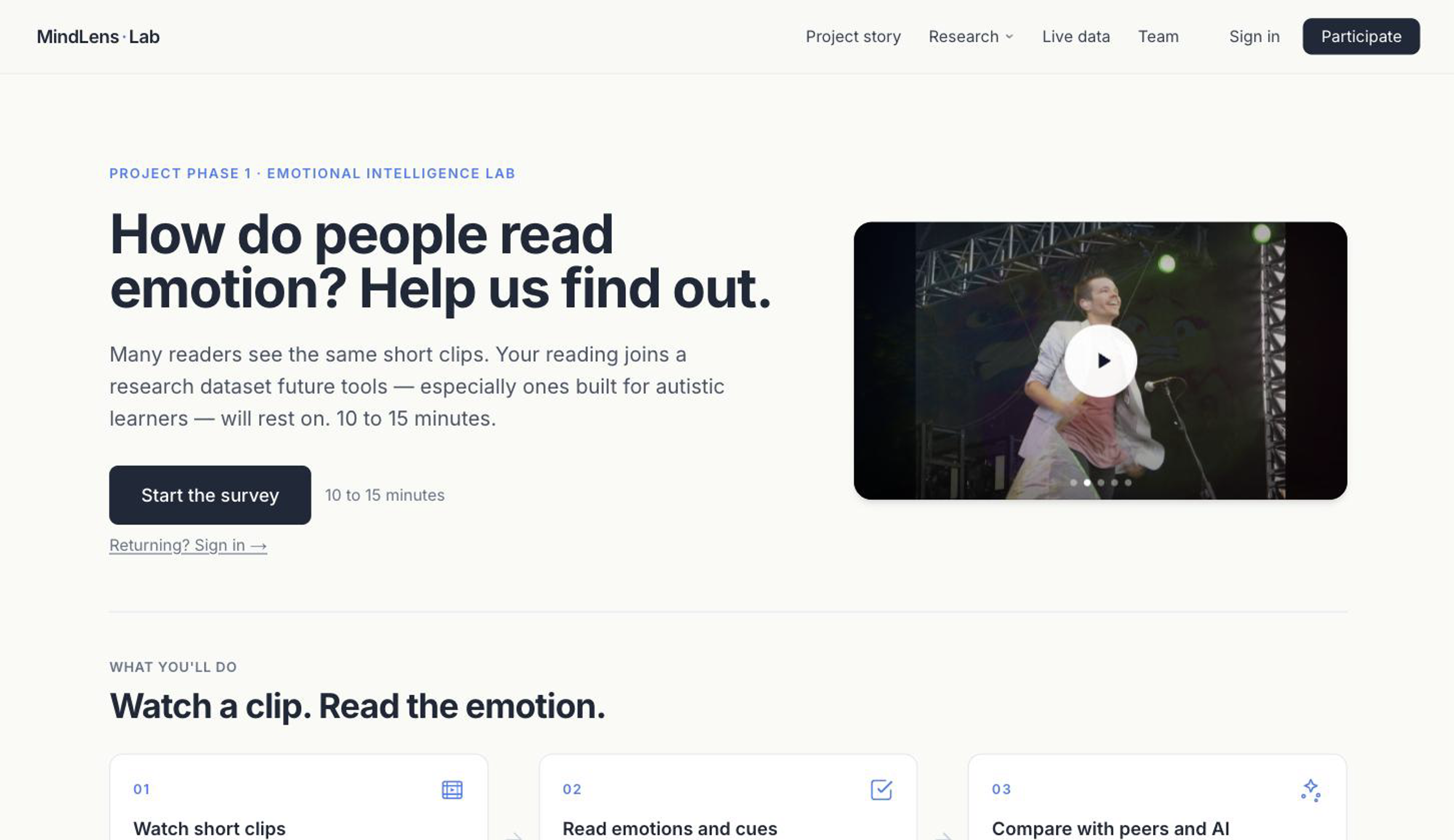
New York, NY, July 03, 2026 --(PR.com)-- MindLens Lab, a non-commercial research project led by 11th-grade student Evelyn Kim at Singapore American School, has opened public participation for its first phase. The study asks contributors to watch ten short video clips (each under 60 seconds) and record how they read each person's emotion — with no right or wrong answers. Participation takes 10 to 15 minutes and requires only an email address; no identifying information is collected. The site is at www.mindlenslab.org.
The project is a direct response to what Kim describes as a foundational blind spot in the emotion-recognition AI that a growing number of learning tools, accessibility apps, and mental-health chatbots now depend on.
"When I was researching AI for autistic learners, I kept running into the same problem — every emotion dataset assumed there was one right answer for how to read a face," Kim said. "That's not how any of us actually experience it. I wanted to build something that starts from that truth instead."
The one-right-answer assumption
Most modern emotion-AI systems are trained on datasets in which a small number of annotators agree on a single label per image — "sadness," "surprise," "anger." Disagreement between annotators is typically treated as noise to be smoothed out. MindLens Lab takes the opposite view: the distribution of readings across many participants is the signal. When ten viewers watch the same 30-second clip and their responses split across sad, moved, embarrassed, and mixed, that spread isn't error — it's the actual thing worth studying.
Every clip in the study is read by dozens of participants. Aggregate results — including where readings converge, where they scatter, and where one AI's reading of the same clip sits within the distribution — are published live on the project's open dashboard at www.mindlenslab.org/data. The full research protocol, including pre-registered hypotheses and analysis thresholds, is published at www.mindlenslab.org/research/hypotheses before any data collection begins.
A teenage researcher with prior work
Kim previously published a paper on AI and autism-related emotion perception in the youth research journal Curieux in 2025. That paper's conclusion — that existing emotion datasets could not support the kind of adaptive learning tools she was arguing for — became the direct motivation for MindLens Lab.
"Phase 1 tests an assumption that a decade of emotion AI has been built on — that everyone reads a face the same way," Kim said. "What we're seeing so far is that the answer is far more layered than that assumption allows."
How to participate
Participation is open to anyone 14 or older, in any country. Contributors watch 10 short clips (each under 60 seconds), pick the emotion or emotions they read on the target person's face, note which cues they used and how confident they felt, and receive their personalized results by email. No real names or identifying data are collected. All research data is anonymized and joins the public dataset at www.mindlenslab.org/data.
What's next
MindLens Lab plans to publish Phase 1 findings in a peer-reviewed journal once the study reaches its pre-registered publication thresholds. Longer-term, the collected dataset is intended as the foundation for a new generation of learning tools designed with autistic learners and others who find emotion reading difficult in mind.
Participate: www.mindlenslab.org
Live data dashboard: www.mindlenslab.org/data
Research protocol: www.mindlenslab.org/research/hypotheses
Media contact: contact@mindlenslab.org
About MindLens Lab
MindLens Lab is a non-commercial research project founded in 2025 by Evelyn Kim, an 11th-grade student at Singapore American School. The project's mission is to build the data foundation for emotion-perception tools that acknowledge the plurality of human reading rather than reducing it to a single right answer.
The project is a direct response to what Kim describes as a foundational blind spot in the emotion-recognition AI that a growing number of learning tools, accessibility apps, and mental-health chatbots now depend on.
"When I was researching AI for autistic learners, I kept running into the same problem — every emotion dataset assumed there was one right answer for how to read a face," Kim said. "That's not how any of us actually experience it. I wanted to build something that starts from that truth instead."
The one-right-answer assumption
Most modern emotion-AI systems are trained on datasets in which a small number of annotators agree on a single label per image — "sadness," "surprise," "anger." Disagreement between annotators is typically treated as noise to be smoothed out. MindLens Lab takes the opposite view: the distribution of readings across many participants is the signal. When ten viewers watch the same 30-second clip and their responses split across sad, moved, embarrassed, and mixed, that spread isn't error — it's the actual thing worth studying.
Every clip in the study is read by dozens of participants. Aggregate results — including where readings converge, where they scatter, and where one AI's reading of the same clip sits within the distribution — are published live on the project's open dashboard at www.mindlenslab.org/data. The full research protocol, including pre-registered hypotheses and analysis thresholds, is published at www.mindlenslab.org/research/hypotheses before any data collection begins.
A teenage researcher with prior work
Kim previously published a paper on AI and autism-related emotion perception in the youth research journal Curieux in 2025. That paper's conclusion — that existing emotion datasets could not support the kind of adaptive learning tools she was arguing for — became the direct motivation for MindLens Lab.
"Phase 1 tests an assumption that a decade of emotion AI has been built on — that everyone reads a face the same way," Kim said. "What we're seeing so far is that the answer is far more layered than that assumption allows."
How to participate
Participation is open to anyone 14 or older, in any country. Contributors watch 10 short clips (each under 60 seconds), pick the emotion or emotions they read on the target person's face, note which cues they used and how confident they felt, and receive their personalized results by email. No real names or identifying data are collected. All research data is anonymized and joins the public dataset at www.mindlenslab.org/data.
What's next
MindLens Lab plans to publish Phase 1 findings in a peer-reviewed journal once the study reaches its pre-registered publication thresholds. Longer-term, the collected dataset is intended as the foundation for a new generation of learning tools designed with autistic learners and others who find emotion reading difficult in mind.
Participate: www.mindlenslab.org
Live data dashboard: www.mindlenslab.org/data
Research protocol: www.mindlenslab.org/research/hypotheses
Media contact: contact@mindlenslab.org
About MindLens Lab
MindLens Lab is a non-commercial research project founded in 2025 by Evelyn Kim, an 11th-grade student at Singapore American School. The project's mission is to build the data foundation for emotion-perception tools that acknowledge the plurality of human reading rather than reducing it to a single right answer.
Contact
MindLensLab
Sean Kim
+65-86060745
mindlenslab.org
Sean Kim
+65-86060745
mindlenslab.org
 Contact
Categories