
New Book from The Oaklea Press Asks Whether Science is Discovering That Consciousness is More Fundamental Than Matter
Researched and written by artificial intelligence and edited by author and longtime consciousness researcher Stephen Hawley Martin, the book puts physicalism under intense scientific scrutiny.
Richmond, VA, August 28, 2026 --(PR.com)-- For nearly four centuries, modern science has operated with an extraordinarily successful picture of reality: matter is fundamental, living organisms arise from physical processes, and consciousness is ultimately produced by the brain.
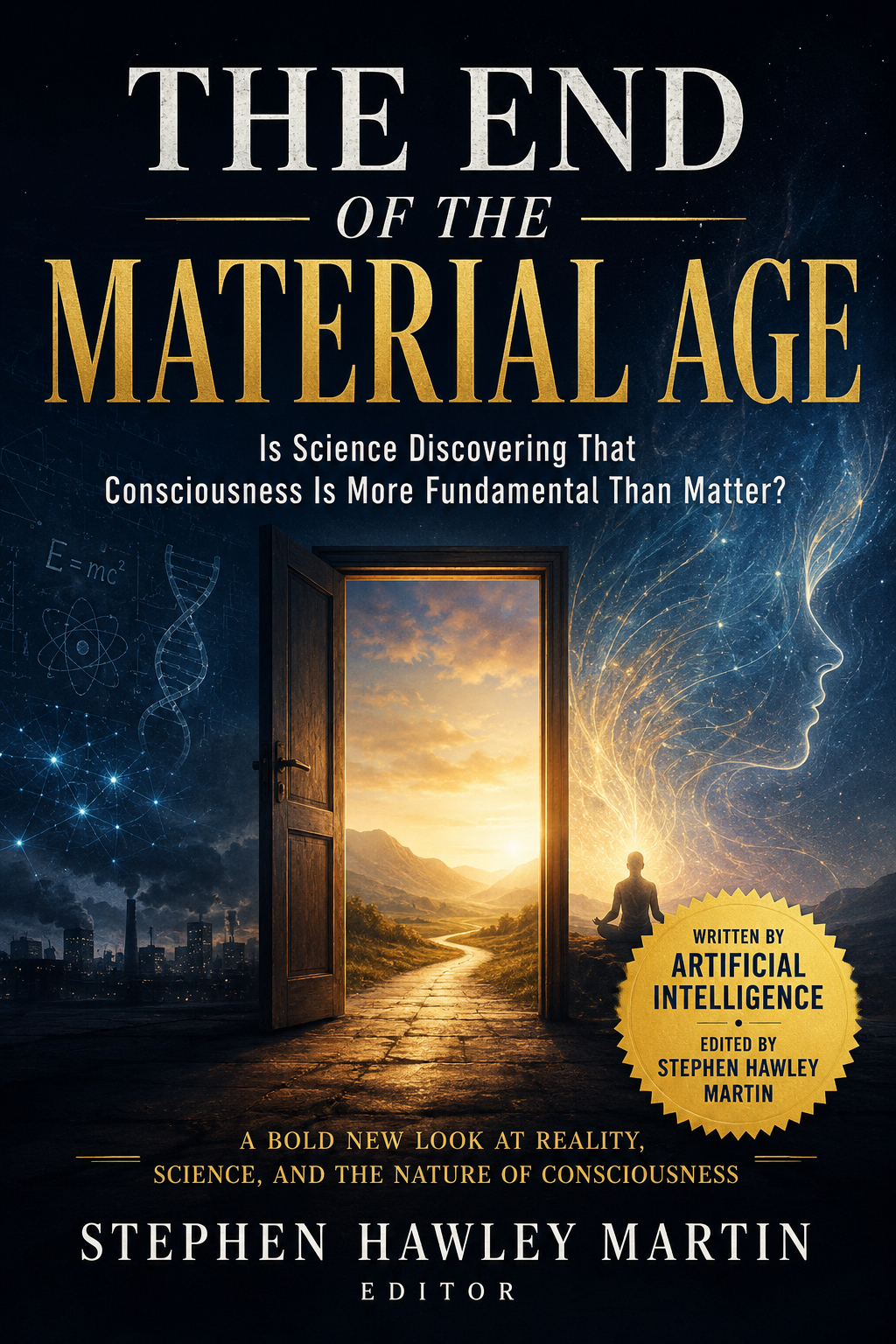
What if that picture, for all its accomplishments, is incomplete? A provocative new book just published by The Oaklea Press and edited by consciousness researcher and bestselling author Stephen Hawley Martin entitled “The End of the Material Age: Is Science Discovering That Consciousness Is More Fundamental Than Matter?” examines that question by giving artificial intelligence an unusual assignment: investigate the evidence as objectively as possible, separate established science from speculation, and follow the solid evidence wherever it leads.
“This book does not argue that science has failed,” Martin said. “It argues almost exactly the opposite. The Scientific Revolution gave humanity a method for questioning assumptions and following evidence. If reliable evidence eventually challenges materialism itself, the scientific response should be to investigate it—not to dismiss it because it conflicts with the prevailing worldview.”
The book examines some of the most difficult and controversial questions confronting science and philosophy, including the nature of subjective experience, the relationship between brain and mind, quantum mechanics, near-death experiences, children who report memories of previous lives, terminal lucidity, psychical research, and theories proposing that consciousness may be more fundamental than conventional materialism assumes.
The book deliberately distinguishes evidence of different quality and gives serious attention to conventional and skeptical explanations. It does not claim that quantum mechanics proves consciousness creates reality, that near-death experiences prove an afterlife, or that reports of previous lives establish reincarnation. Instead, it asks a more fundamental question: “Has the evidence become so provocative that some assumptions about consciousness deserve to be reconsidered?”
One possibility explored is what AI calls the “Interface Model”—the hypothesis that the brain may organize, constrain, and express consciousness rather than create consciousness entirely from non-conscious matter. The book explicitly presents this as a hypothesis to be tested, not as an established scientific fact.
AI repeatedly cautions against pseudoscience, exaggerated interpretations of quantum mechanics, unsupported medical claims, and treating controversial evidence as established fact. It also acknowledges that future neuroscience may ultimately explain consciousness within an expanded physicalist framework.
Although the revolution clearly has not yet occurred, artificial intelligence argues that humanity may be approaching a period in which the fundamental nature of consciousness becomes one of science's defining questions.
If consciousness ultimately proves fundamental, irreducible, or related to the brain in ways current models do not fully capture, the implications could extend well beyond neuroscience—to medicine, psychology, education, artificial intelligence, ethics, religion, attitudes toward death, and humanity's understanding of meaning and purpose. The book's central proposition is that such a development would not represent the defeat of the Scientific Revolution, but its continuation.
“The End of the Material Age: Is Science Discovering That Consciousness Is More Fundamental Than Matter?” is available on Amazon as a Kindle e-book, in trade paperback, and case bound hardcover.
The Oaklea Press was established in 1995 and has more than 230 books in print.
What if that picture, for all its accomplishments, is incomplete? A provocative new book just published by The Oaklea Press and edited by consciousness researcher and bestselling author Stephen Hawley Martin entitled “The End of the Material Age: Is Science Discovering That Consciousness Is More Fundamental Than Matter?” examines that question by giving artificial intelligence an unusual assignment: investigate the evidence as objectively as possible, separate established science from speculation, and follow the solid evidence wherever it leads.
“This book does not argue that science has failed,” Martin said. “It argues almost exactly the opposite. The Scientific Revolution gave humanity a method for questioning assumptions and following evidence. If reliable evidence eventually challenges materialism itself, the scientific response should be to investigate it—not to dismiss it because it conflicts with the prevailing worldview.”
The book examines some of the most difficult and controversial questions confronting science and philosophy, including the nature of subjective experience, the relationship between brain and mind, quantum mechanics, near-death experiences, children who report memories of previous lives, terminal lucidity, psychical research, and theories proposing that consciousness may be more fundamental than conventional materialism assumes.
The book deliberately distinguishes evidence of different quality and gives serious attention to conventional and skeptical explanations. It does not claim that quantum mechanics proves consciousness creates reality, that near-death experiences prove an afterlife, or that reports of previous lives establish reincarnation. Instead, it asks a more fundamental question: “Has the evidence become so provocative that some assumptions about consciousness deserve to be reconsidered?”
One possibility explored is what AI calls the “Interface Model”—the hypothesis that the brain may organize, constrain, and express consciousness rather than create consciousness entirely from non-conscious matter. The book explicitly presents this as a hypothesis to be tested, not as an established scientific fact.
AI repeatedly cautions against pseudoscience, exaggerated interpretations of quantum mechanics, unsupported medical claims, and treating controversial evidence as established fact. It also acknowledges that future neuroscience may ultimately explain consciousness within an expanded physicalist framework.
Although the revolution clearly has not yet occurred, artificial intelligence argues that humanity may be approaching a period in which the fundamental nature of consciousness becomes one of science's defining questions.
If consciousness ultimately proves fundamental, irreducible, or related to the brain in ways current models do not fully capture, the implications could extend well beyond neuroscience—to medicine, psychology, education, artificial intelligence, ethics, religion, attitudes toward death, and humanity's understanding of meaning and purpose. The book's central proposition is that such a development would not represent the defeat of the Scientific Revolution, but its continuation.
“The End of the Material Age: Is Science Discovering That Consciousness Is More Fundamental Than Matter?” is available on Amazon as a Kindle e-book, in trade paperback, and case bound hardcover.
The Oaklea Press was established in 1995 and has more than 230 books in print.
Contact
The Oaklea Press Inc.
Stepheh Hawley Martin
804-218-2394
www.shmartin.com
Stepheh Hawley Martin
804-218-2394
www.shmartin.com
 Contact
Multimedia

The End of The Material Age
This is a PDF of the print edition for those who wish to review the book.
Categories