
POWER Applauds Introduction of SAFE Act to Strengthen Oversight of Temporary Staffing Agencies and Protect California Workers
California is one of the few large labor markets that does not currently require comprehensive statewide registration and licensing of temporary staffing agencies before they begin operations. (See attached chart)
Sacramento, CA, February 12, 2026 --(PR.com)-- The Partnership Organization for Workplace Ethics and Reform (P.O.W.E.R.) today announced its strong support for the introduction of the SAFE Act (Staffing Agency Fair Enforcement Act), landmark legislation, Senate Bill (SB) 1032, authored by State Senator Eloise Gómez Reyes, that establishes a statewide registration and compliance framework for temporary staffing agencies operating in California.
Sponsored by the United Food and Commercial Workers (UFCW) Western States Council, the UFCW 8 - Golden State Joint Labor Management Committee, and POWER, the SAFE Act is designed to modernize oversight of a rapidly expanding sector of the labor market while protecting workers, responsible employers, and taxpayers from the growing consequences of staffing-related fraud.
“California’s fragmented labor enforcement system leaves workers and families exposed,” said Senator Eloise Gómez Reyes (D-Colton). “This bill establishes clear oversight, real accountability, and upfront verification so staffing agencies are complying with the law before harm can occur. I look forward to engaging with stakeholders as we strengthen protections for workers and level the playing field for responsible employers.”
“Temporary staffing plays a vital role in California’s economy, but oversight has not kept pace with the scale and complexity of third-party employment,” said POWER Spokesperson Dan Kramer. “The SAFE Act introduces commonsense verification standards that help ensure workers are protected, businesses compete fairly, and public systems are not forced to absorb avoidable costs.”
Addressing a Critical Oversight Gap
California is one of the few large labor markets that does not currently require comprehensive statewide registration and licensing of staffing agencies before they begin operations. This absence of front-end verification has allowed some bad actors — including operators based outside the state — to establish staffing entities, collect payments from employer clients, and fail to remit payroll taxes, insurance premiums, and other legally required obligations, as well as participate in other labor code violations, including rampant employee wage theft.
When enforcement actions occur, fraudulent operators may dissolve the entity and reopen under a new name, restarting the cycle and leaving workers, businesses, and taxpayers exposed.
At the same time, oversight responsibilities are fragmented across multiple entities, including local district attorneys, the Department of Insurance, the Department of Industrial Relations, taxing authorities, and the Workers’ Compensation Appeals Board. Because these cases often involve complex corporate structures and cross-jurisdictional issues, investigations can take years and are not always prioritized over more immediate public safety matters.
As the percentage of California’s workforce employed through staffing arrangements continues to grow, the human and financial consequences of fraud increase year over year.
“This is not a partisan issue, and it is certainly not a victimless crime,” Kramer added. “When uninsured employment persists, injured workers can be pushed onto taxpayer-funded healthcare programs, responsible businesses face unfair competition, and public systems become the payer of last resort.”
Key Provisions of the SAFE Act
The legislation adds a new section to the Labor Code establishing baseline safeguards for staffing agencies, including:
Mandatory annual registration with the Labor Commissioner before conducting business
Disclosure of ownership interests, background checks, disclosure of financial condition, and outstanding liabilities
Verified proof of active workers’ compensation coverage
A surety bond requirement to strengthen financial accountability
Authority to issue stop-work orders for uninsured operators
A publicly accessible registry of compliant staffing agencies
A requirement that businesses verify registration before using staffing services
Enforceable remedies against unregistered operators
Together, these measures shift California toward a preventative oversight model designed to detect risk before harm occurs.
Protecting Workers and Responsible Employers
The SAFE Act also seeks to stabilize the workers’ compensation system and promote fair competition by ensuring that companies that follow the law are not undercut by operators that avoid legally required labor costs.
The California Department of Insurance recently identified approximately $1.2 billion in chargeable fraud in a single year, underscoring the importance of early detection mechanisms and coordinated oversight.
“Most staffing firms operate responsibly,” said Kramer. “This legislation supports those employers by reinforcing clear, predictable rules across the marketplace.”
A Collaborative Path Forward
POWER emphasized that the SAFE Act reflects a pragmatic approach to governance — one focused on transparency, accountability, and fiscal responsibility.
“Oversight should scale with payroll risk,” Kramer said. “The SAFE Act modernizes California’s labor infrastructure in a way that protects workers while supporting ethical businesses and safeguarding taxpayer resources.”
POWER looks forward to working with lawmakers, labor leaders, employers, and enforcement stakeholders to advance the legislation and strengthen integrity within California’s contingent labor market.
About POWER
The Partnership Organization for Workplace Ethics and Reform (POWER) is a nonprofit coalition dedicated to exposing fraud in the temporary staffing industry, protecting workers, supporting responsible employers, and advancing policy solutions that promote transparency, accountability, and fair competition.
Sponsored by the United Food and Commercial Workers (UFCW) Western States Council, the UFCW 8 - Golden State Joint Labor Management Committee, and POWER, the SAFE Act is designed to modernize oversight of a rapidly expanding sector of the labor market while protecting workers, responsible employers, and taxpayers from the growing consequences of staffing-related fraud.
“California’s fragmented labor enforcement system leaves workers and families exposed,” said Senator Eloise Gómez Reyes (D-Colton). “This bill establishes clear oversight, real accountability, and upfront verification so staffing agencies are complying with the law before harm can occur. I look forward to engaging with stakeholders as we strengthen protections for workers and level the playing field for responsible employers.”
“Temporary staffing plays a vital role in California’s economy, but oversight has not kept pace with the scale and complexity of third-party employment,” said POWER Spokesperson Dan Kramer. “The SAFE Act introduces commonsense verification standards that help ensure workers are protected, businesses compete fairly, and public systems are not forced to absorb avoidable costs.”
Addressing a Critical Oversight Gap
California is one of the few large labor markets that does not currently require comprehensive statewide registration and licensing of staffing agencies before they begin operations. This absence of front-end verification has allowed some bad actors — including operators based outside the state — to establish staffing entities, collect payments from employer clients, and fail to remit payroll taxes, insurance premiums, and other legally required obligations, as well as participate in other labor code violations, including rampant employee wage theft.
When enforcement actions occur, fraudulent operators may dissolve the entity and reopen under a new name, restarting the cycle and leaving workers, businesses, and taxpayers exposed.
At the same time, oversight responsibilities are fragmented across multiple entities, including local district attorneys, the Department of Insurance, the Department of Industrial Relations, taxing authorities, and the Workers’ Compensation Appeals Board. Because these cases often involve complex corporate structures and cross-jurisdictional issues, investigations can take years and are not always prioritized over more immediate public safety matters.
As the percentage of California’s workforce employed through staffing arrangements continues to grow, the human and financial consequences of fraud increase year over year.
“This is not a partisan issue, and it is certainly not a victimless crime,” Kramer added. “When uninsured employment persists, injured workers can be pushed onto taxpayer-funded healthcare programs, responsible businesses face unfair competition, and public systems become the payer of last resort.”
Key Provisions of the SAFE Act
The legislation adds a new section to the Labor Code establishing baseline safeguards for staffing agencies, including:
Mandatory annual registration with the Labor Commissioner before conducting business
Disclosure of ownership interests, background checks, disclosure of financial condition, and outstanding liabilities
Verified proof of active workers’ compensation coverage
A surety bond requirement to strengthen financial accountability
Authority to issue stop-work orders for uninsured operators
A publicly accessible registry of compliant staffing agencies
A requirement that businesses verify registration before using staffing services
Enforceable remedies against unregistered operators
Together, these measures shift California toward a preventative oversight model designed to detect risk before harm occurs.
Protecting Workers and Responsible Employers
The SAFE Act also seeks to stabilize the workers’ compensation system and promote fair competition by ensuring that companies that follow the law are not undercut by operators that avoid legally required labor costs.
The California Department of Insurance recently identified approximately $1.2 billion in chargeable fraud in a single year, underscoring the importance of early detection mechanisms and coordinated oversight.
“Most staffing firms operate responsibly,” said Kramer. “This legislation supports those employers by reinforcing clear, predictable rules across the marketplace.”
A Collaborative Path Forward
POWER emphasized that the SAFE Act reflects a pragmatic approach to governance — one focused on transparency, accountability, and fiscal responsibility.
“Oversight should scale with payroll risk,” Kramer said. “The SAFE Act modernizes California’s labor infrastructure in a way that protects workers while supporting ethical businesses and safeguarding taxpayer resources.”
POWER looks forward to working with lawmakers, labor leaders, employers, and enforcement stakeholders to advance the legislation and strengthen integrity within California’s contingent labor market.
About POWER
The Partnership Organization for Workplace Ethics and Reform (POWER) is a nonprofit coalition dedicated to exposing fraud in the temporary staffing industry, protecting workers, supporting responsible employers, and advancing policy solutions that promote transparency, accountability, and fair competition.
Contact
POWER
Dan Kramer
1 (803) 715-1421
www.poweraction.org
Dan Kramer
1 (803) 715-1421
www.poweraction.org
 Contact
Multimedia
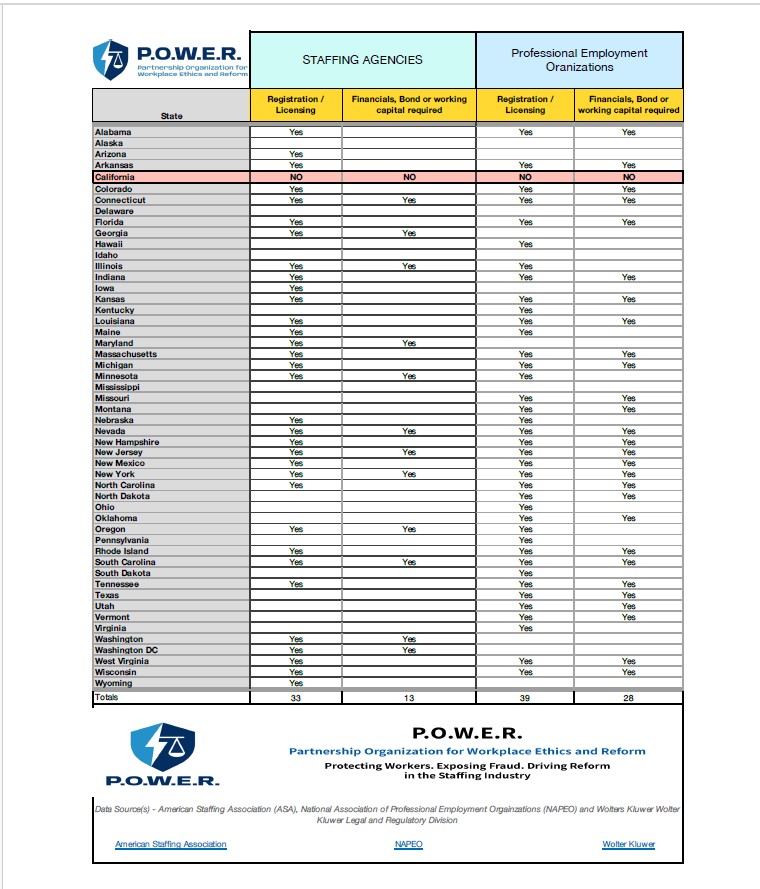
State by State Staffing Agency Registration Requirements
Complete listing of all United States Temporary Staffing Registration Requirements - all states.
Categories