
Texas Independents Send Early Signal: Policy Alignment Alone is Not Enough
New statewide U.S. Senate primary research finds collaborative versus combative tone and alignment with President Trump shape independent support in both Democratic and Republican contests.
Austin, TX, February 19, 2026 --(PR.com)-- A new statewide study of 1,070 Texas independent voters finds that communication style and perceived tone shape support in both Republican and Democratic primaries. On the Republican side, perceived alignment with President Donald Trump may rival policy positions in influencing independent voters.
The study was commissioned by BallotReady and conducted by Tavern Research, with consultation from independent political scientists. Researchers tested reactions to Democratic debate clips and Republican policy messaging in the 2026 Texas U.S. Senate race. Across both primaries, candidates viewed as steady and solutions-oriented gained support, while those perceived as combative or strongly partisan underperformed.
Republican Primary: Policy Strength vs. Message
After reviewing written policy messaging from U.S. Sen. John Cornyn, U.S. Rep. Wesley Hunt, and Texas Attorney General Ken Paxton, independents signaled that policy leadership does not always translate into overall message strength.
Cornyn led on every major policy tested, including border security (53 percent), healthcare (50 percent), and the economy and taxes (56 percent). Yet independents selected Hunt (41 percent) over Cornyn (38 percent) when asked who would be the better senator.
Hunt’s appeal centered on presentation, with 30 percent citing “fresh leadership and generational change.” Cornyn was described as pragmatic and knowledgeable, with 40 percent citing competence as a strength, while 30 percent identified “Trump/MAGA alignment” as their primary concern.
Paxton generated a divided response: 42 percent of positive mentions described him as “patriotic,” while negatives clustered around generalized opposition (17 percent), immigration concerns (16 percent), and a “litigation-first” leadership style (16 percent).
Across both parties, candidates perceived as more confrontational struggled to consolidate independent support.
Democratic Primary: Debate Tone Produces 3-to-1 Margin
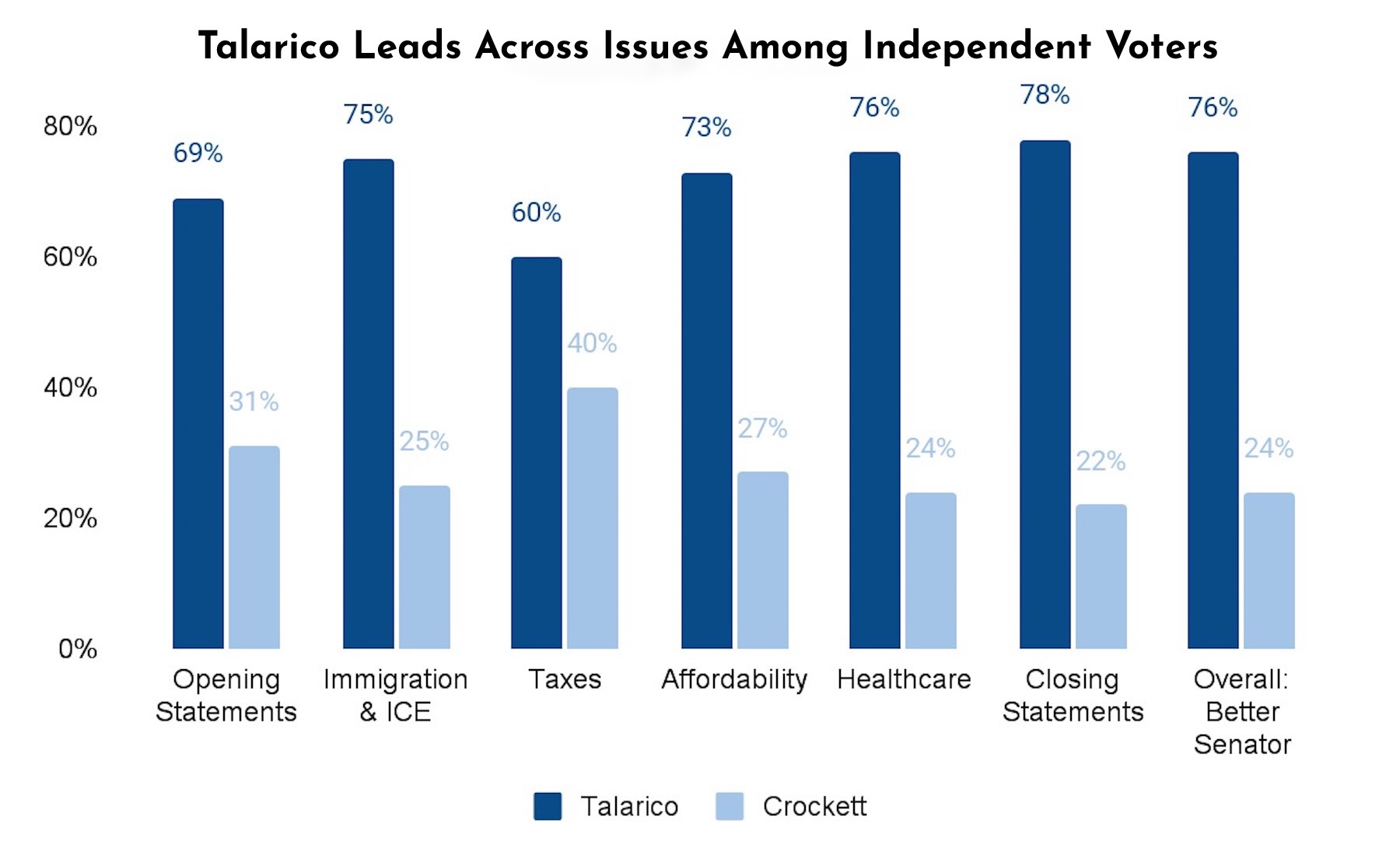
After viewing clips from the January 24 Democratic primary debate, independent voters preferred James Talarico over Jasmine Crockett by a 76 percent to 24 percent margin when asked who would make a better senator. Before debate exposure, Talarico led 56 percent to 44 percent.
The advantage extended across every segment tested. Talarico led on immigration (75–25), healthcare (76–24), closing statements (78–22), and all other debate topics. His standing rose +19 points after debate exposure, more than double Crockett’s +9 gain.
Independents most frequently cited Talarico’s “calm, confident demeanor” (32 percent), “authentic, relatable background” (28 percent), and “prepared, knowledgeable, specific plans” (26 percent). Crockett drew praise for passion and toughness, but higher criticism for communication clarity (32 percent) and tone described by some as overly combative.
Among independents, assertiveness did not broaden appeal. The televised debate appeared decisive: Talarico’s modest pre-debate lead widened steadily to a 3-to-1 margin by the end, underscoring the importance of live candidate exposure.
National Context
Texas is among the first states to hold 2026 primaries. As one of the country’s largest and most competitive states, its electorate offers directional insight. In 2025, Gallup reported a record 45 percent of U.S. adults identifying as independents, surpassing both major parties.
The Tavern Research findings suggest persuadable voters did not uniformly reject conservative or progressive positions. Rather, they responded more favorably to candidates perceived as steady and forward-looking, and less favorably to those associated with confrontation or strong partisan alignment. Tone may increasingly function as a threshold test for broader viability.
Methodology
Tavern Research fielded an online survey of 1,070 Texas independent voters from February 8–14, 2026. The five-step design measured baseline attitudes, exposed respondents to Democratic debate clips across six policy segments, tested post-debate matchups, presented Republican written policy positions across five issues, and measured final matchups.
Democratic candidates were evaluated via video and Republican candidates via text, so comparisons were conducted within parties rather than across parties. The margin of error is 5.5 percent.
Full toplines and cross-tabulations are available upon request.
About Tavern Research
Tavern Research is an opinion research and analytics firm using survey science and experimentation to deliver actionable insights grounded in measured public attitudes. tavernresearch.com
About BallotReady
BallotReady is a free, nonpartisan civic platform providing fact-checked, ballot-specific information to help voters explore every race and measure, make a plan to vote, and engage in civic life. ballotready.org
The study was commissioned by BallotReady and conducted by Tavern Research, with consultation from independent political scientists. Researchers tested reactions to Democratic debate clips and Republican policy messaging in the 2026 Texas U.S. Senate race. Across both primaries, candidates viewed as steady and solutions-oriented gained support, while those perceived as combative or strongly partisan underperformed.
Republican Primary: Policy Strength vs. Message
After reviewing written policy messaging from U.S. Sen. John Cornyn, U.S. Rep. Wesley Hunt, and Texas Attorney General Ken Paxton, independents signaled that policy leadership does not always translate into overall message strength.
Cornyn led on every major policy tested, including border security (53 percent), healthcare (50 percent), and the economy and taxes (56 percent). Yet independents selected Hunt (41 percent) over Cornyn (38 percent) when asked who would be the better senator.
Hunt’s appeal centered on presentation, with 30 percent citing “fresh leadership and generational change.” Cornyn was described as pragmatic and knowledgeable, with 40 percent citing competence as a strength, while 30 percent identified “Trump/MAGA alignment” as their primary concern.
Paxton generated a divided response: 42 percent of positive mentions described him as “patriotic,” while negatives clustered around generalized opposition (17 percent), immigration concerns (16 percent), and a “litigation-first” leadership style (16 percent).
Across both parties, candidates perceived as more confrontational struggled to consolidate independent support.
Democratic Primary: Debate Tone Produces 3-to-1 Margin
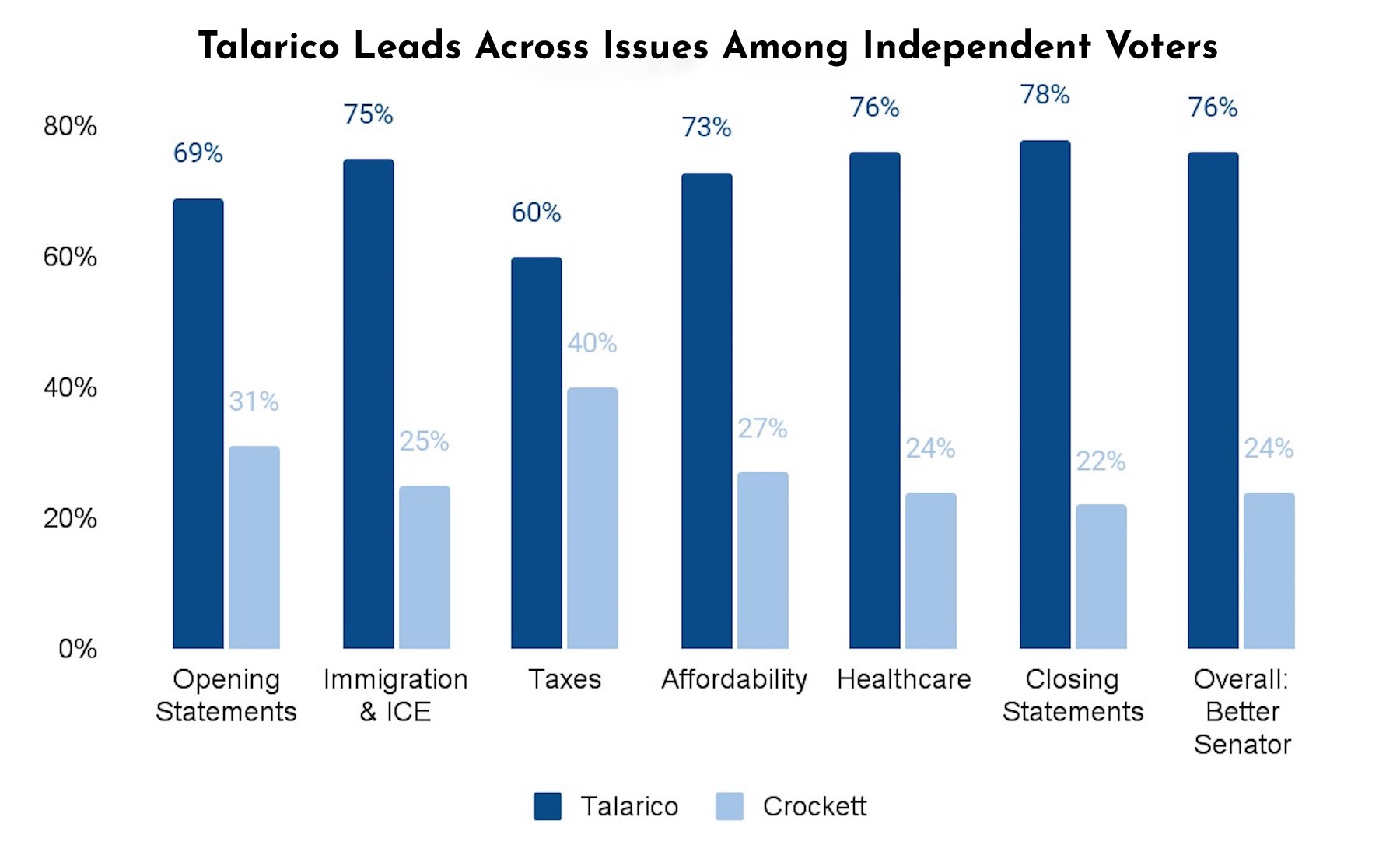
After viewing clips from the January 24 Democratic primary debate, independent voters preferred James Talarico over Jasmine Crockett by a 76 percent to 24 percent margin when asked who would make a better senator. Before debate exposure, Talarico led 56 percent to 44 percent.
The advantage extended across every segment tested. Talarico led on immigration (75–25), healthcare (76–24), closing statements (78–22), and all other debate topics. His standing rose +19 points after debate exposure, more than double Crockett’s +9 gain.
Independents most frequently cited Talarico’s “calm, confident demeanor” (32 percent), “authentic, relatable background” (28 percent), and “prepared, knowledgeable, specific plans” (26 percent). Crockett drew praise for passion and toughness, but higher criticism for communication clarity (32 percent) and tone described by some as overly combative.
Among independents, assertiveness did not broaden appeal. The televised debate appeared decisive: Talarico’s modest pre-debate lead widened steadily to a 3-to-1 margin by the end, underscoring the importance of live candidate exposure.
National Context
Texas is among the first states to hold 2026 primaries. As one of the country’s largest and most competitive states, its electorate offers directional insight. In 2025, Gallup reported a record 45 percent of U.S. adults identifying as independents, surpassing both major parties.
The Tavern Research findings suggest persuadable voters did not uniformly reject conservative or progressive positions. Rather, they responded more favorably to candidates perceived as steady and forward-looking, and less favorably to those associated with confrontation or strong partisan alignment. Tone may increasingly function as a threshold test for broader viability.
Methodology
Tavern Research fielded an online survey of 1,070 Texas independent voters from February 8–14, 2026. The five-step design measured baseline attitudes, exposed respondents to Democratic debate clips across six policy segments, tested post-debate matchups, presented Republican written policy positions across five issues, and measured final matchups.
Democratic candidates were evaluated via video and Republican candidates via text, so comparisons were conducted within parties rather than across parties. The margin of error is 5.5 percent.
Full toplines and cross-tabulations are available upon request.
About Tavern Research
Tavern Research is an opinion research and analytics firm using survey science and experimentation to deliver actionable insights grounded in measured public attitudes. tavernresearch.com
About BallotReady
BallotReady is a free, nonpartisan civic platform providing fact-checked, ballot-specific information to help voters explore every race and measure, make a plan to vote, and engage in civic life. ballotready.org
Contact
Oleta Media
Jennifer Swanson
512-731-9486
Jennifer Swanson
512-731-9486
 Contact
Multimedia
Categories