
AI Search Strategist Kaleigh Moore Unveils the "Source Signal Stack," a New AEO Framework for Earning LLM Citations
AI search and AEO (Answer Engine Optimization) strategist Kaleigh Moore today introduced the Source Signal Stack, a four-layer diagnostic framework designed to explain why B2B companies that rank well in traditional search still fail to earn citations in AI-generated answers.
Austin, TX, April 23, 2026 --(PR.com)-- As March 2026 data from Profound indicates that LinkedIn is now the #1 most-cited domain for professional queries across ChatGPT, Google AI Mode, and Perplexity, Kaleigh Moore argues that B2B brands are overlooking their single biggest citation lever: their own employees.
Today, AI search and AEO (Answer Engine Optimization) strategist Kaleigh Moore introduced the Source Signal Stack, a four-layer diagnostic framework designed to explain why B2B companies that rank well in traditional search still fail to earn citations in AI-generated answers.
The framework arrives at a moment of sharp disruption in B2B search. Recent AirOps data indicates that 85% of AI citations now come from third-party platforms rather than brand-owned properties, and Moz research shows 88% of Google AI Mode citations do not appear in the organic top-10 search results. In parallel, the Profround study indicates LinkedIn has climbed from roughly the #11 most-cited domain on ChatGPT in November 2025 to approximately #5 by February 2026 — more than doubling its citation frequency in a single quarter and overtaking Wikipedia, YouTube, and every major news publisher for professional queries.
"The B2B content model of the past decade does not copy-paste over to optimizing for LLM citations," said Moore. "Large language models aren't just evaluating content anymore—they're evaluating people. They're asking whether the person attached to a given idea is a credible, independently verifiable source. Most B2B companies have one or two entities carrying that weight: a CEO with a LinkedIn presence and a company blog. That's a top-heavy stack in a game that rewards breadth of independent verification."
The Source Signal Stack
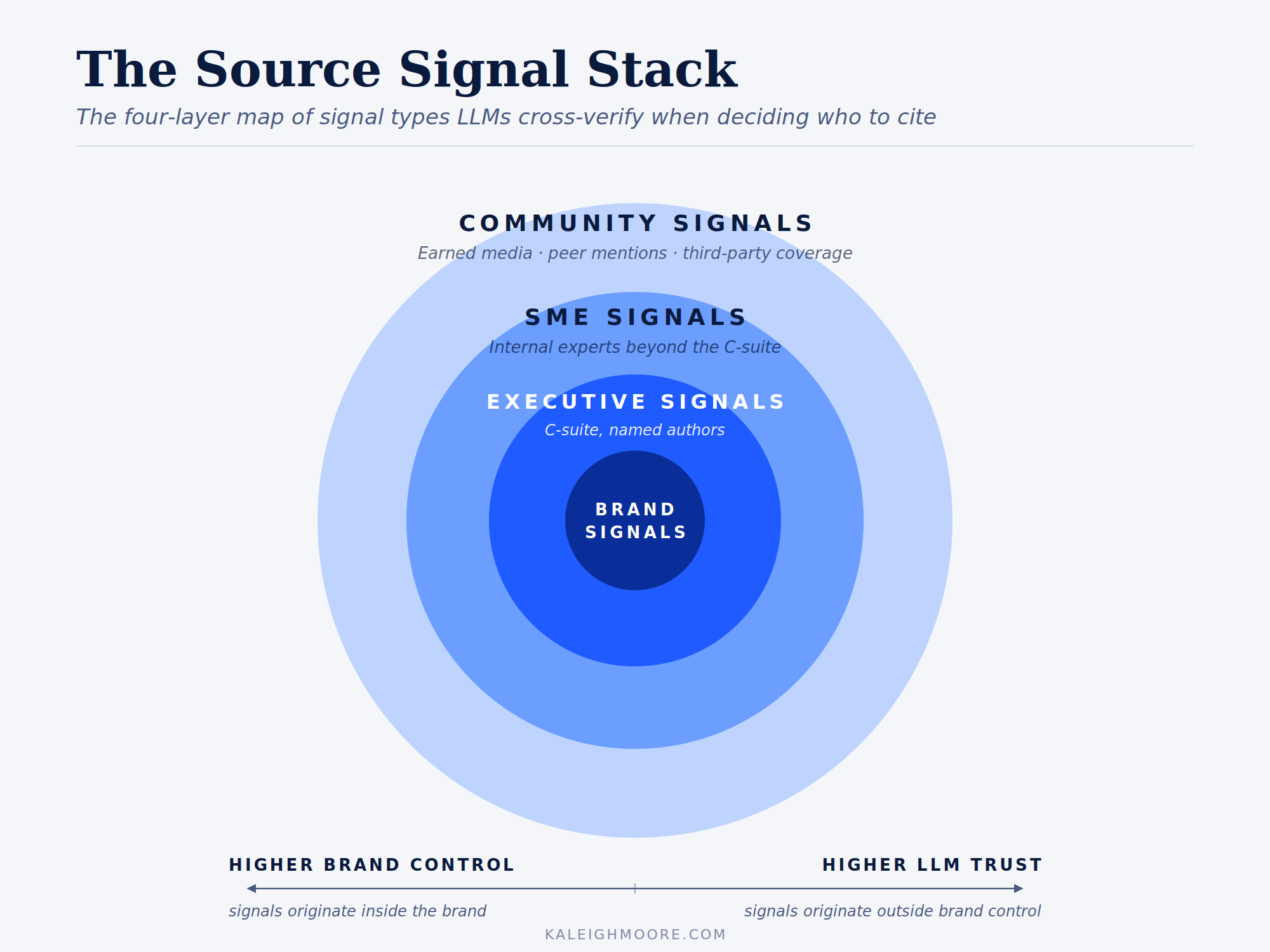
The Source Signal Stack organizes citation-earning infrastructure into four layers, ordered by the degree of independence LLMs attribute to each:
Layer 1 — Brand Signals: Owned properties such as the company website, blog, documentation, and LinkedIn company page.
Layer 2 — Executive Signals: Named C-suite voices publishing under their own bylines on LinkedIn, podcasts, op-eds, and at industry events.
Layer 3 — SME Signals: Non-executive internal experts — product managers, solutions engineers, senior customer success leaders, staff engineers, researchers — publishing original perspectives under their own names.
Layer 4 — Community Signals: Earned media, peer mentions, trade press quotes, podcast appearances, and independent third-party references.
The core insight, Moore argues, is that the further a source signal originates from brand control, the more weight LLMs assign to it—meaning most B2B content programs are over-investing in the layer AI systems trust the least while leaving the highest-leverage layer, Layer 3, almost entirely inactive.
Moore cites Content Marketing Institute research showing that 96% of B2B companies produce thought leadership content, but only 37% involve employees with specialized knowledge in those efforts — and fewer than 5% of a company's total employee roster typically participates.
Why LinkedIn, and Why Now
Supporting the framework's Layer 3 emphasis, Moore points to several recent data sets:
A SEMrush analysis of 325,000 AI prompts identifying 89,000 unique LinkedIn URLs cited across ChatGPT Search, Google AI Mode, and Perplexity.
Profound's review of 1.4 million citations from November 2025 through February 2026, which found LinkedIn to be the most-cited domain for professional queries and showed that on ChatGPT and Google AI Mode, 59% of cited LinkedIn content originates from individual members rather than company pages.
SEMrush findings that LinkedIn articles between 500 and 2,000 words account for 72–77% of AI citations, 95% of cited LinkedIn content is original, and 75% of AI-cited authors publish at least five times per month.
DigitalBloom research indicating that brands and people mentioned positively across four or more non-affiliated platforms are 2.8x more likely to appear in ChatGPT responses.
"Authority compounds," Moore said. "Once LLMs anchor their entity graphs around a set of named humans at a competitor's company, the cost for your SMEs to displace them goes up significantly. The cheapest moment to build this infrastructure is before your category's AI citation patterns harden — and based on what I'm seeing, that's happening faster in B2B than almost anyone expected."
About Kaleigh Moore
Kaleigh Moore is a former Forbes journalist turned GEO/AEO strategist and a Harvard graduate student studying AI ethics and information retrieval. She works with SaaS teams to ship better content faster, show up in AI-generated answers, and build the editorial systems that make both sustainable. She publishes the weekly newsletter Context Window on the intersection of B2B content, AI search, and editorial strategy.
More at https://www.kaleighmoore.com.
Contact:
Kaleigh Moore
hello@kaleighmoore.com
Today, AI search and AEO (Answer Engine Optimization) strategist Kaleigh Moore introduced the Source Signal Stack, a four-layer diagnostic framework designed to explain why B2B companies that rank well in traditional search still fail to earn citations in AI-generated answers.
The framework arrives at a moment of sharp disruption in B2B search. Recent AirOps data indicates that 85% of AI citations now come from third-party platforms rather than brand-owned properties, and Moz research shows 88% of Google AI Mode citations do not appear in the organic top-10 search results. In parallel, the Profround study indicates LinkedIn has climbed from roughly the #11 most-cited domain on ChatGPT in November 2025 to approximately #5 by February 2026 — more than doubling its citation frequency in a single quarter and overtaking Wikipedia, YouTube, and every major news publisher for professional queries.
"The B2B content model of the past decade does not copy-paste over to optimizing for LLM citations," said Moore. "Large language models aren't just evaluating content anymore—they're evaluating people. They're asking whether the person attached to a given idea is a credible, independently verifiable source. Most B2B companies have one or two entities carrying that weight: a CEO with a LinkedIn presence and a company blog. That's a top-heavy stack in a game that rewards breadth of independent verification."
The Source Signal Stack
The Source Signal Stack organizes citation-earning infrastructure into four layers, ordered by the degree of independence LLMs attribute to each:
Layer 1 — Brand Signals: Owned properties such as the company website, blog, documentation, and LinkedIn company page.
Layer 2 — Executive Signals: Named C-suite voices publishing under their own bylines on LinkedIn, podcasts, op-eds, and at industry events.
Layer 3 — SME Signals: Non-executive internal experts — product managers, solutions engineers, senior customer success leaders, staff engineers, researchers — publishing original perspectives under their own names.
Layer 4 — Community Signals: Earned media, peer mentions, trade press quotes, podcast appearances, and independent third-party references.
The core insight, Moore argues, is that the further a source signal originates from brand control, the more weight LLMs assign to it—meaning most B2B content programs are over-investing in the layer AI systems trust the least while leaving the highest-leverage layer, Layer 3, almost entirely inactive.
Moore cites Content Marketing Institute research showing that 96% of B2B companies produce thought leadership content, but only 37% involve employees with specialized knowledge in those efforts — and fewer than 5% of a company's total employee roster typically participates.
Why LinkedIn, and Why Now
Supporting the framework's Layer 3 emphasis, Moore points to several recent data sets:
A SEMrush analysis of 325,000 AI prompts identifying 89,000 unique LinkedIn URLs cited across ChatGPT Search, Google AI Mode, and Perplexity.
Profound's review of 1.4 million citations from November 2025 through February 2026, which found LinkedIn to be the most-cited domain for professional queries and showed that on ChatGPT and Google AI Mode, 59% of cited LinkedIn content originates from individual members rather than company pages.
SEMrush findings that LinkedIn articles between 500 and 2,000 words account for 72–77% of AI citations, 95% of cited LinkedIn content is original, and 75% of AI-cited authors publish at least five times per month.
DigitalBloom research indicating that brands and people mentioned positively across four or more non-affiliated platforms are 2.8x more likely to appear in ChatGPT responses.
"Authority compounds," Moore said. "Once LLMs anchor their entity graphs around a set of named humans at a competitor's company, the cost for your SMEs to displace them goes up significantly. The cheapest moment to build this infrastructure is before your category's AI citation patterns harden — and based on what I'm seeing, that's happening faster in B2B than almost anyone expected."
About Kaleigh Moore
Kaleigh Moore is a former Forbes journalist turned GEO/AEO strategist and a Harvard graduate student studying AI ethics and information retrieval. She works with SaaS teams to ship better content faster, show up in AI-generated answers, and build the editorial systems that make both sustainable. She publishes the weekly newsletter Context Window on the intersection of B2B content, AI search, and editorial strategy.
More at https://www.kaleighmoore.com.
Contact:
Kaleigh Moore
hello@kaleighmoore.com
Contact
Kaleigh Moore LLC
Kaleigh Moore
217-725-4523
kaleighmoore.com
Kaleigh Moore
217-725-4523
kaleighmoore.com
 Contact
Categories